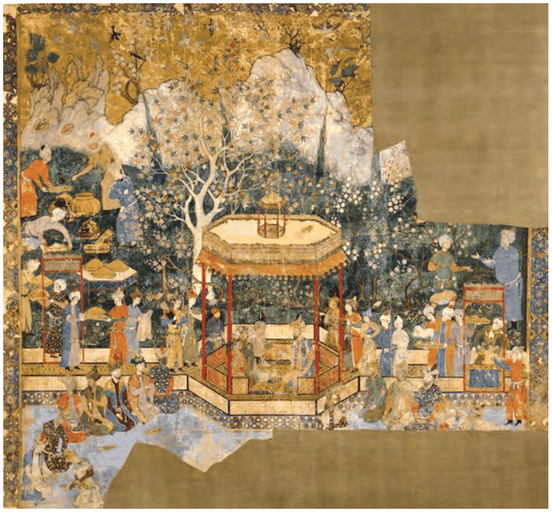
Princes of the House of Timur (1545–50) is an early Mughal painting. Its original portraits were later painted over to register successive members of the Mughal dynasty. Whose portraits are visible in it, painted over the original ones?
Answer & explanation
Correct answer: option 2
The correct answer is Option (2) → Akbar, Jahangir and Shah Jahan
Option (1) Babur, Humayun and Akbar — Incorrect. The original portraits were painted during the reign of Humayun. Babur and Humayun are not among the later portraits.
Option (2) Akbar, Jahangir and Shah Jahan — Correct. These three portraits were painted subsequently over those of Humayun’s reign.
Option (3) Jahangir, Shah Jahan and Aurangzeb — Incorrect. Aurangzeb is not named among the later portraits. The set begins with Akbar.
Option (4) Humayun, Akbar and Jahangir — Incorrect. Humayun’s reign is when the original portraits were made. The later set ends with Shah Jahan.
Note: This topic was not named in the CUET 2026 syllabus, but it was part of the NCERT chapter. In 2025 and 2026, NTA also asked questions on topics in NCERT that the CUET syllabus did not name. So our mocks have questions from every part of the NCERT chapter, to give you enough practice. Read the whole chapter, not only the sub-topics named in the syllabus.
NCERT (2026-27): “Early Mughal Painting …When we look at an extraordinary Mughal painting from the early period, Princes of the House of Timur (1545–50), probably by Safavid artist, Abd us Samad, in opaque watercolour on cotton, we are surprised by its size and complex structure and display of historical portraits. A prized possession of the imperial family, it has portraits that were painted over the original to register the portraits of successive members of the Mughal dynasty. So, visible in their physical likeness are portraits of Akbar, Jahangir and Shah Jahan painted subsequently over those painted during the reign of Humayun.”
“Princes of the House of Timur, Abd us Samad, 1545–50, British Museum, London” |