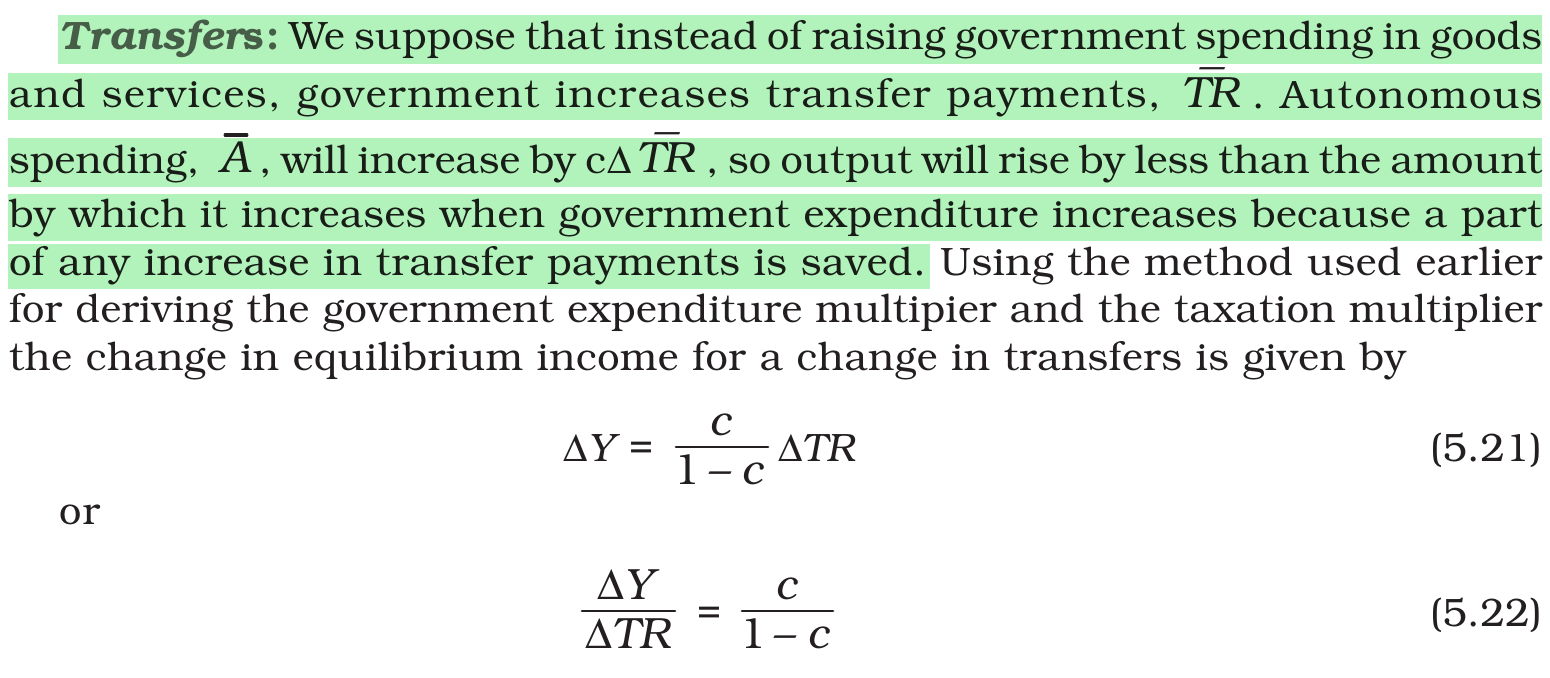
If the government changes transfer payments (\( \overline{TR} \)), autonomous spending (\( \bar A \)) will change by?
Answer & explanation
Correct answer: option 2
The correct answer is Option (2) → \( c*\Delta TR \)
A change in transfer payments changes autonomous spending by c × ΔTR, because households spend only the part c of any extra income.
Transfer payments are payments by the government for which it gets no goods or services in return. A rise in them raises the disposable income of households by ΔTR. Here c is the marginal propensity to consume, the part of each extra rupee that is spent. The rest is saved. So only c × ΔTR reaches the market as new spending. For this reason, output rises by less than when government spending on goods and services rises by the same amount.
NCERT (2026-27): Introductory Macroeconomics — Chapter 5: Government Budget and the Economy
|