Which of the following statements is/are incorrect?
Answer & explanation
Correct answer: option 2
The correct answer is Option (2) → The value of \(K_H\) is independent of temperature.
Henry’s law states that, at a constant temperature, the solubility of a gas in a liquid is directly proportional to the partial pressure of the gas above it. In terms of mole fraction:
\( \displaystyle p = K_H\,x \qquad \text{so} \qquad x = \frac{p}{K_H} \)
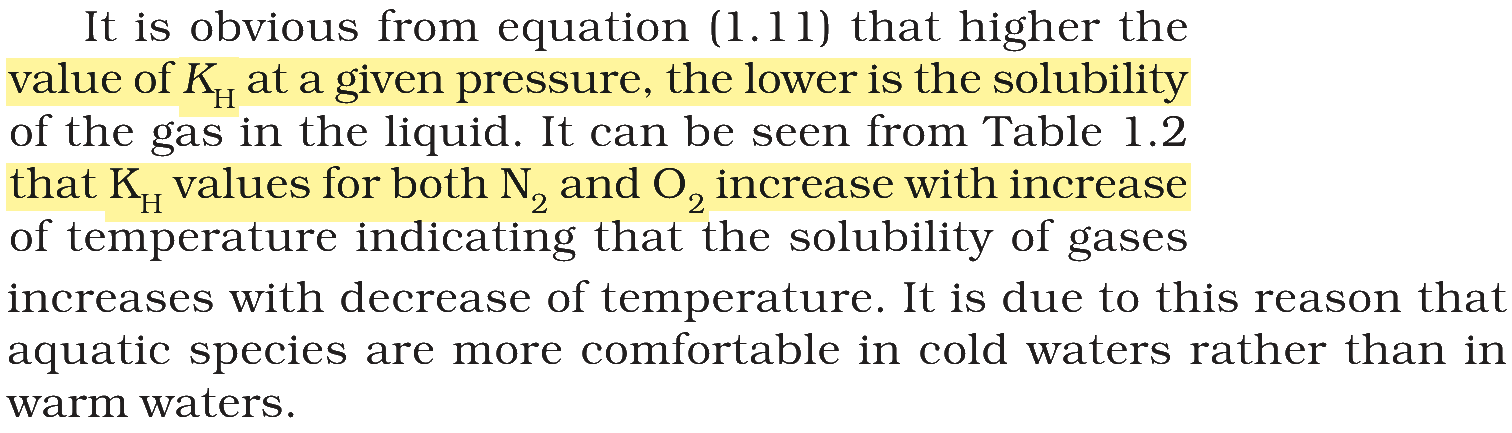
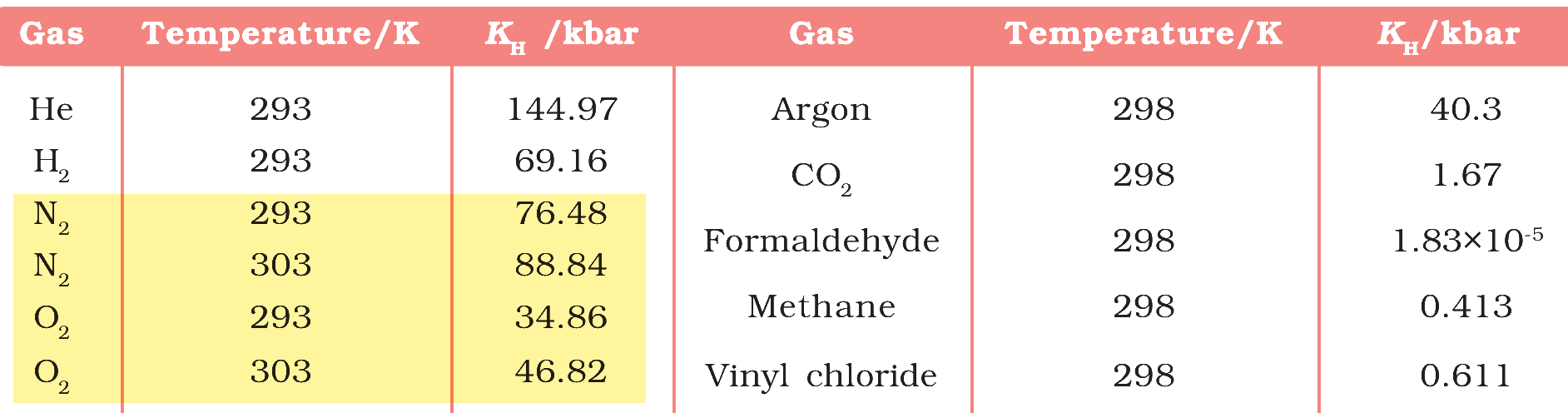
KH depends on the nature of the gas and on the temperature. For gases such as \( \ce{N2} \) and \( \ce{O2} \) in water, KH increases as the temperature rises, which means that gases become less soluble in warm water.
Option (1) Solubility of gases is inversely proportional to the \(K_H\) value at the given pressure. — A correct statement about Henry’s law. From \( x = p/K_H \), at a given pressure a higher KH means a lower solubility.
Option (2) The value of \(K_H\) is independent of temperature. — Not a correct statement. KH of \( \ce{N2} \) and \( \ce{O2} \) in water rises with temperature (Table 1.2).
Option (3) Raoult law is a special case of Henry’s law. — A correct statement about Henry’s law. Raoult’s law, \( p_1 = p_1^{\circ}x_1 \), has the same form as Henry’s law; it is the special case in which KH becomes equal to \( p_1^{\circ} \).
Option (4) The solubility of a gas in a liquid varies directly with the partial pressure of gas over liquid surface. — A correct statement about Henry’s law. This is Henry’s law itself; it is why soft drink bottles are sealed under high pressure of \( \ce{CO2} \).
NCERT (2026-27 edition):
Solubility of a Gas in a Liquid – …