
Six point charges are kept at the vertices of a regular hexagon of side a and centre O is shown. The correct statement(s) are: (Given \( K = \displaystyle\frac{1}{4\pi\varepsilon_0}\frac{q}{a^{2}} \)).
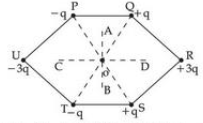
(A) Net electric field at O is 8K along OU.
(B) Electric field at O will be zero if all charges are of same magnitude and sign.
(C) Electric potential at all points on the line AB is same.
(D) Electric potential at all points on the line CD is same.
(E) Electric potential at centre O is zero.
Choose the correct answer from the options given below:
Answer & explanation
Correct answer: option 4
The correct answer is Option (4) → (A), (B), (C) and (E) only
Every vertex is at the same distance a from O, so a charge q at a vertex gives a field of magnitude K at O and a potential \( \frac{1}{4\pi\varepsilon_0}\frac{q}{a} \) at O. The field is a vector, so directions matter; the potential is a scalar, so the charges simply add with their signs.
(A) Net electric field at O is 8K along OU — Correct. The charges +3q at R and −3q at U both give a field along OU, which adds up to 3K + 3K = 6K. The pairs +q at Q with −q at T, and −q at P with +q at S, lie on opposite ends of a diameter, so each pair gives 2K along the diameter towards the negative charge. Their components along OU add up to 2K, while the components perpendicular to OU cancel. The net field is 6K + 2K = 8K along OU.
(B) Electric field at O will be zero if all charges are of same magnitude and sign — Correct. The fields of the two charges at the ends of any diameter are equal and opposite, so the three pairs cancel.
(C) Electric potential at all points on the line AB is same — Correct. AB is the perpendicular bisector of PQ, TS and UR, and each of these pairs has equal and opposite charges, so the potential is zero all along AB.
(D) Electric potential at all points on the line CD is same — Incorrect. CD passes through U and R; the potential is zero at O but large and negative near U and large and positive near R.
(E) Electric potential at centre O is zero — Correct. The potential at O is \( \frac{1}{4\pi\varepsilon_0 a}\left(-q + q + 3q + q - q - 3q\right) = 0 \), because the charges add up to zero.