Measure the level of ex-ante aggregate demand when autonomous investment and consumption expenditure (A) is Rs 80 crores, and MPC is 0.75.
Answer & explanation
Correct answer: option 3
The correct answer is Option (3) → 320 crore
Given:
Autonomous investment and consumption expenditure, A = Rs 80 crores
Marginal propensity to consume (MPC), c = 0.75
Aggregate demand has an autonomous part A, which does not depend on income, and a part that rises with income, cY. These figures fix it only at equilibrium, where output Y equals aggregate demand:
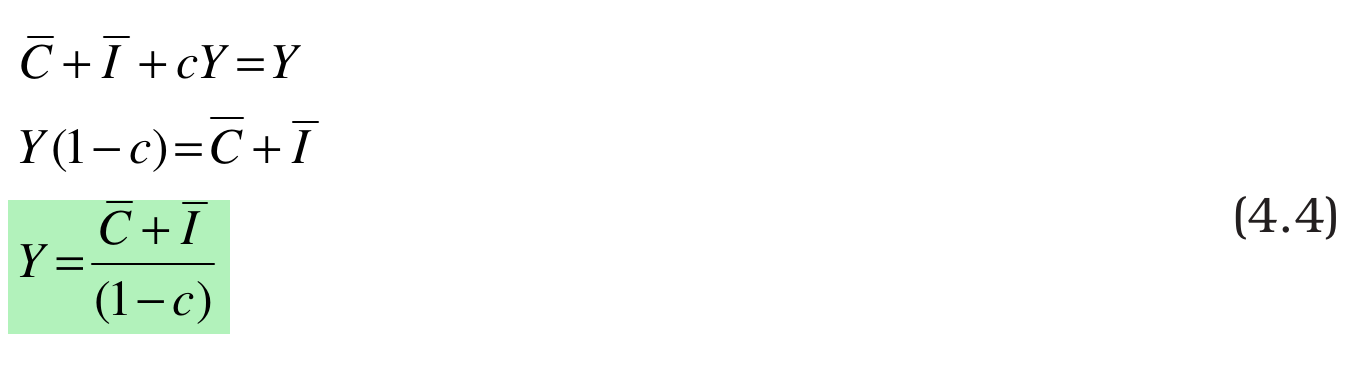
Y = A + cY
Y (1 − c) = A
Y = A ÷ (1 − c)
Y = 80 ÷ (1 − 0.75)
Y = 80 ÷ 0.25 = Rs 320 crore
Check: aggregate demand at this income is 80 + (0.75 × 320), which is 320.
NCERT (2026-27): “4.2 DETERMINATION OF INCOME IN TWO-SECTOR MODEL … Substituting the values of C and I from equations (4.1) and (4.2), aggregate demand for final goods can be written as AD = C̄ + Ī + c.Y If the final goods market is in equilibrium this can be written as Y = C̄ + Ī + c.Y where Y is the ex ante, or planned, ouput of final goods. This equation can be further simplified by adding up the two autonomous terms, C̄ and Ī, making it Y = Ā + c.Y (4.3) where Ā = C̄ + Ī is the total autonomous expenditure in the economy. … A word of caution is in order. The term Y on the left hand side of equation (4.3) represents the ex ante output or the planned supply of final goods. On the other hand, the expression on the right hand side denotes ex ante or planned aggregate demand for final goods in the economy. Ex ante supply is equal to ex ante demand only when the final goods market, and hence the economy, is in equilibrium.…”
|