CUETMOCK
  • Pricing
  • Mentors
Log inStart freeStart free mocks→

First test, then trust

Try a free CUET mock test.

Join 5,00,000+ students who rehearsed exam day on the exact NTA screen before sitting CUET. On the web and on Android.

Start free mocks →Get the Android app
CUETMOCK

India's #1 CUET Mock Test Platform. Original NCERT-based questions on the exact NTA exam screen — trusted by 5,00,000+ students since CUET 2022.

Get it onGoogle PlayScan to download the CUETMOCK app

Mock tests

  • CUET mock test series
  • Browse all papers
  • Commerce mocks
  • Humanities (Arts) mocks
  • Science mocks
  • Languages & GAT mocks
  • Free practice questions
  • Pricing

Resources

  • CUET exam guide
  • CUET syllabus
  • Universities accepting CUET
  • Expert blogs
  • News & notifications
  • Webinars & counselling
  • CUET score calculator
  • How we estimate your rank
  • FAQs

Company

  • About us
  • Our leadership & team
  • Our toppers
  • Mentors
  • For schools
  • Contact us
  • Terms
  • Privacy
  • Refund policy

Talk to us

+91 7696 6630 56info@cuetmock.comWhatsApp us

Our other platforms

  • JEE Mock — For IIT-JEE aspirants
  • NEET Mock — For NEET aspirants

Newsletter

Exam updates, study material and offers — no spam.

© 2026 NYC Ventures Pvt. Ltd.

701-702, Royal Business Park, Zirakpur, Punjab - 140603

  • Terms of use
  • Privacy policy
  • Refund policy
  • Contact us

iCUETMOCK is an independent preparation platform, not affiliated with the National Testing Agency (NTA). Always check exam details on the official NTA website.

  • Home
  • Mock tests
  • CUET guide
  • Pricing
  • Log in
Home/Practice questions/Economics
EconomicsIndian Economic Development: Environment and Sustainable Development

Central Pollution Control Board (CPCB) helps the town plan officials…

Read the passage given below and answer the question.

Pollution Control Boards

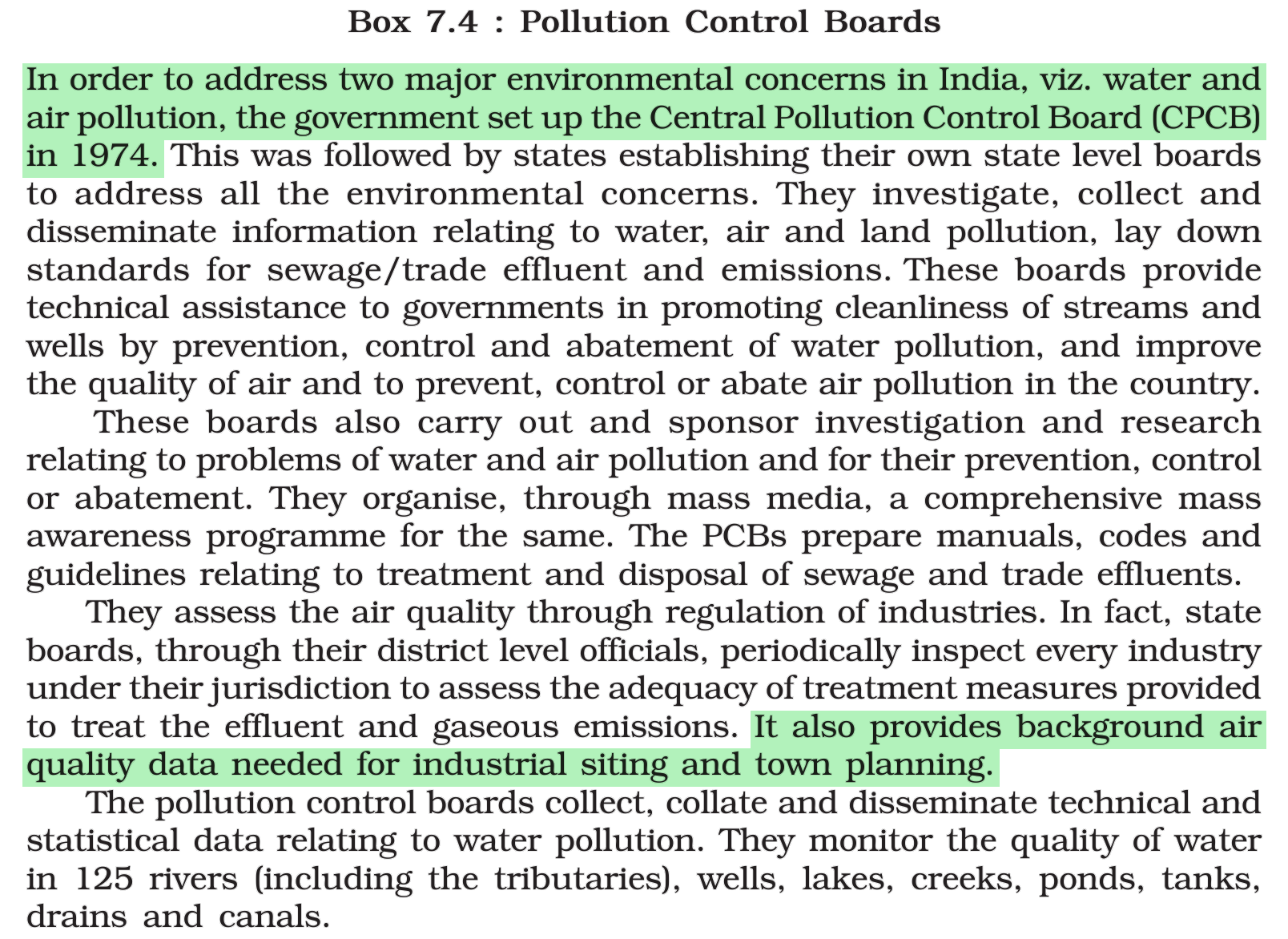
In order to address two major environmental concerns in India, viz. water and air pollution, the government set up the Central Pollution Control Board (CPCB) in 1974. This was followed by states establishing their own state level boards to address all the environmental concerns. They investigate, collect and disseminate information relating to water, air and land pollution, lay down standards for sewage/trade effluent and emissions. These boards provide technical assistance to Governments in promoting cleanliness of streams and wells by prevention, control and abatement of water pollution, and improve the quality of air and to prevent, control or abate air pollution in the country.

These boards also carry out and sponsor investigation and research relating to problems of water and air pollution and for their prevention, control or abatement. They also organise, through mass media, a comprehensive mass awareness programme for the same. The PCBs prepare manuals, codes and guidelines relating to treatment and disposal of sewage and trade effluents.

They assess the air quality through regulation of industries. In fact, state boards, through their district level officials, periodically inspect every industry under their jurisdiction to assess the adequacy of treatment measures provided to treat the effluent and gaseous emissions. It also provides background air quality data needed for industrial siting and town planning.

The pollution control boards collect, collate and disseminate technical and statistical data relating to water pollution. They monitor the quality of water in 125 rivers (including the tributaries), wells, lakes, creeks, ponds, tanks, drains and canals.

Central Pollution Control Board (CPCB) helps the town plan officials by providing them :

Answer & explanation+

Correct answer: option 2

The correct answer is Option (2) → Air Quality Data

The boards check the air around industries. In doing so they collect background air quality data, which officials need when they choose sites for industries and plan towns.

Note: This passage is taken from the box ‘Pollution Control Boards’ of the chapter ‘Environment and Sustainable Development’ of the NCERT book. Small boxes in the chapters are worth a careful read. This one alone gave five questions here.

NCERT (2026-27): Indian Economic Development — Chapter 7: Environment and Sustainable Development

NCERT extract

Advertisement

Practise more on Indian Economic Development: Environment and Sustainable Development

Chapter-wise mocks on the real NTA exam screen, with solutions and your rank. Your first mocks are free.

Start free mocks →

Advertisement

Next questions

  1. The nature of electromagnetic wave is:Physics · Electromagnetic Waves
  2. Certain texts, compiled by Brahmanas by about the middle of the first millennium CE, contained stories about gods and goddesses. Why were t…History · Ancient India: Thinkers, Beliefs and Buildings
  3. Over 95% of all existing transgenic animals are:Biology · Biotechnology and its Applications
  4. निम्नलिखित में से किसमें आधुनिक राजनितिक देशी भाषा की विशेषता निहित हैं?Hindi · Comprehension - (Narrative / Factual)
  5. Which of the following industry fulfils man’s basic need of mobility ?Geography · Fundamentals of Human Geography: Transport and Communication
  6. Observe the graph and choose the correct option from the following:Biology · Organisms and Populations
  7. Select the most appropriate synonym of the underlined word in the given sentence. Isn't knowledge supposed to make life sweeter and happier?English · Synonyms
  8. ‘Rule of Law’ in our Constitution have been borrowed from which of the following country?Legal Studies · Judiciary
  9. 'मधुशाला' काव्य कृति के रचनाकार हैं -Hindi · हिंदी साहित्य (रचना, रचनाकार और विधाएँ)
  10. Choose the option that is the correct passive form of the sentence. She ate the last slice of pizza.English · Grammar: Active Passive Voice