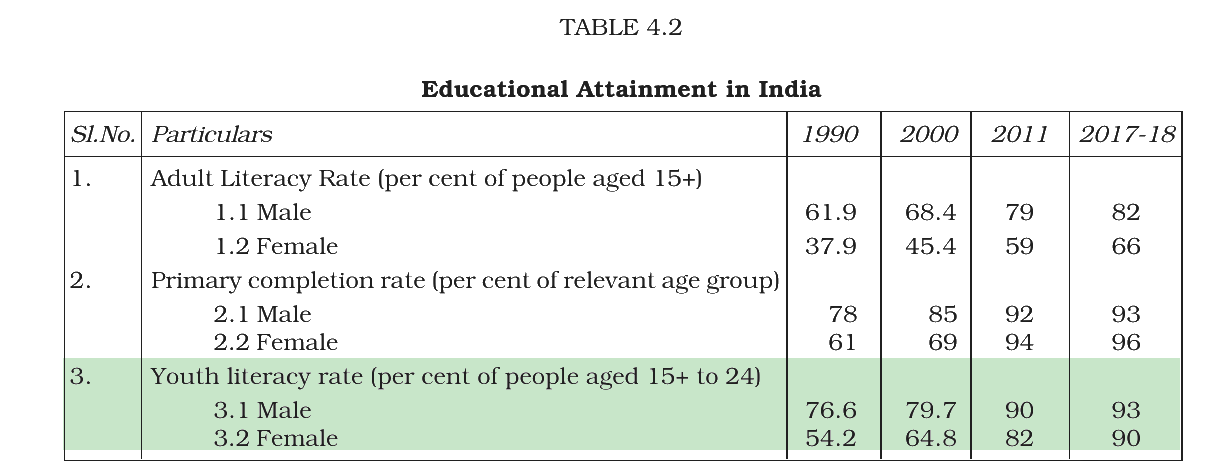
The table gives the youth literacy rate (per cent of people aged 15+ to 24) in India.
| Year | Male | Female |
|---|---|---|
| 1990 | 76.6 | 54.2 |
| 2000 | 79.7 | 64.8 |
| 2011 | 90 | 82 |
| 2017-18 | 93 | 90 |
Which of the following statements is correct?
Answer & explanation
Correct answer: option 1
The correct answer is Option (1) → The female rate rose by more percentage points between 2000 and 2011 than in either of the other two periods shown.
Rise in the female rate in each period:
1990 to 2000: 64.8 − 54.2 = 10.6 points
2000 to 2011: 82 − 64.8 = 17.2 points
2011 to 2017-18: 90 − 82 = 8 points
Option (1) The female rate rose by more percentage points between 2000 and 2011 than in either of the other two periods shown. — Correct. 17.2 points is the largest rise.
Option (2) The male rate rose by more percentage points than the female rate between 2000 and 2011. — Incorrect. The male rate rose by 90 − 79.7 = 10.3 points, less than 17.2.
Option (3) The gap between the male and female rates was wider in 2000 than in 1990. — Incorrect. The gap was 22.4 points in 1990 and 14.9 points in 2000, so it narrowed.
Option (4) The female rate was above the male rate in 2017-18. — Incorrect. It was 90 against 93.
NCERT (2026-27): “Gender Equity — Better than Before: The differences in literacy rates between males and females are narrowing signifying a positive development in gender equity; still the need to promote education for women in India is imminent for various reasons such as improving economic independence and social status of women and also because women education makes a favourable impact on fertility rate and health care of women and children. …” |