
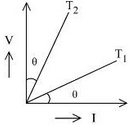
V-I graph for a platinum wire at temperatures \( T_1 \) and \( T_2 \) is shown in the given figure. The temperature difference \( (T_2 - T_1) \) is proportional to:
Answer & explanation
Correct answer: option 4
The correct answer is Option (4) → \( \cot 2\theta \)
On a V-I graph the slope \( V/I \) is the resistance. The resistance of a metal wire rises with temperature as
\( \displaystyle R = R_0\left[1 + \alpha\,(T - T_0)\right] \;\Rightarrow\; R_2 - R_1 = R_0\,\alpha\,(T_2 - T_1) \)
So \( (T_2 - T_1) \propto (R_2 - R_1) \).
Readings from the figure:
\( T_1 \text{ line makes } \theta \text{ with the } I\text{-axis: } R_1 = \tan\theta \)
\( T_2 \text{ line makes } \theta \text{ with the } V\text{-axis, so } (90^\circ - \theta) \text{ with the } I\text{-axis: } R_2 = \cot\theta \)
\( \displaystyle R_2 - R_1 = \cot\theta - \tan\theta = \frac{\cos^{2}\theta - \sin^{2}\theta}{\sin\theta\cos\theta} \)
Using \( \cos^{2}\theta - \sin^{2}\theta = \cos 2\theta \) and \( \sin\theta\cos\theta = \frac{1}{2}\sin 2\theta \):
\( \displaystyle R_2 - R_1 = \frac{\cos 2\theta}{\frac{1}{2}\sin 2\theta} = 2\cot 2\theta \)
\( \displaystyle T_2 - T_1 \propto \cot 2\theta \)