Match List-I with List-II
| List-I | List-II |
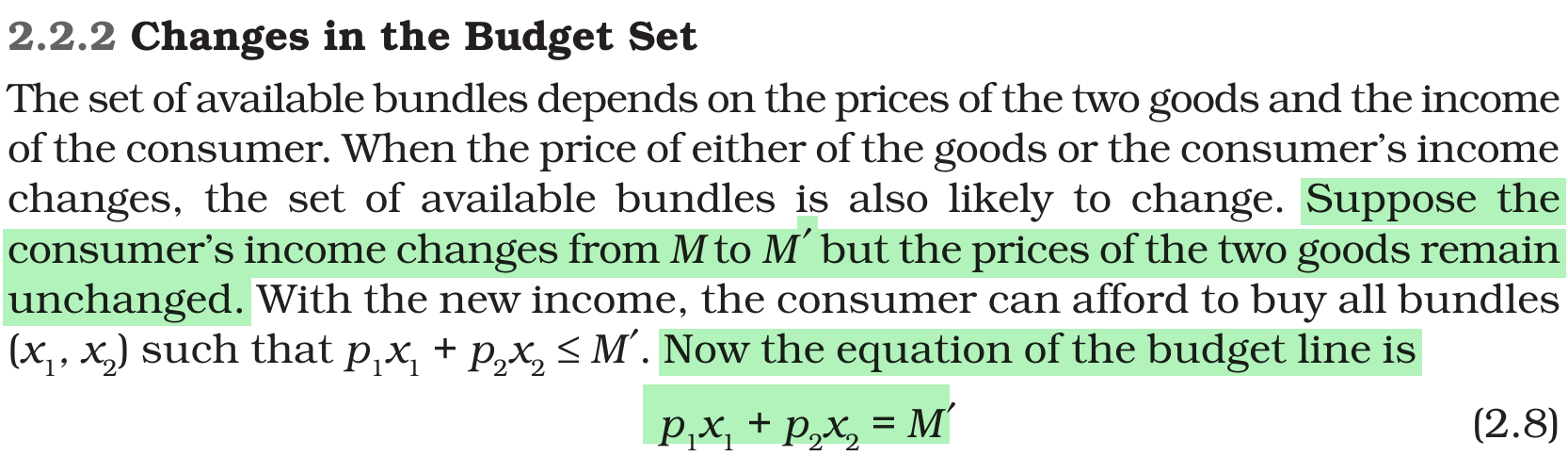
| (A) Consumer's income changes, but prices remain unchanged. The equation of the budget line. | (I) \( p_1 x_1 + p_2 x_2 = M' \) |
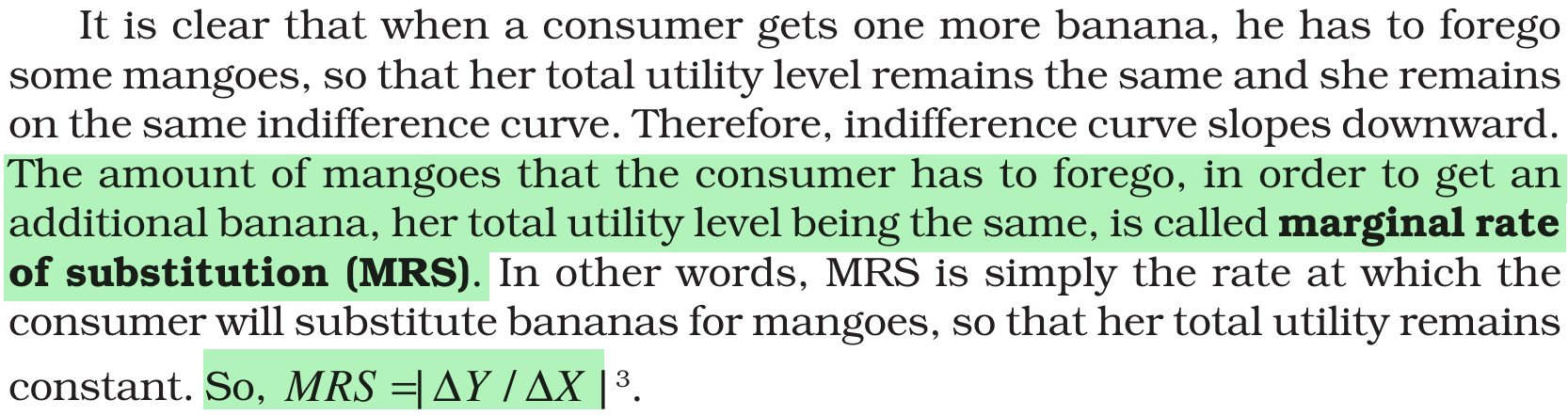
| (B) Marginal Rate of Substitution (MRS) | (II) \( p'_1 x_1 + p_2 x_2 = M \) |
| (C) The price of a commodity changes, but income remains unchanged. The equation of the budget line. | (III) \( ΔY/ΔX \) |
| (D) Total Utility | (IV) \( MU_1+ MU_2+ ... + MU_{n-1} + MU_n \) |
Choose the correct answer from the options given below:
Answer & explanation
Correct answer: option 2
The correct answer is Option (2) → (A)-(I), (B)-(III), (C)-(II), (D)-(IV)
The budget line shows the bundles that cost the whole income: \( p_1 x_1 + p_2 x_2 = M \). A change in income changes M, and a change in a price changes that p. Utility is the satisfaction from consuming a good.
| List-I | List-II | Reason |
|---|---|---|
| (A) Consumer's income changes, but prices remain unchanged. The equation of the budget line. | (I) \( p_1 x_1 + p_2 x_2 = M' \) | Only income changes, from M to M'. The prices stay the same, so the new line is parallel to the old one. |
| (B) Marginal Rate of Substitution (MRS) | (III) \( ΔY/ΔX \) | MRS is the rate at which the consumer substitutes one good for the other and stays equally satisfied. It is the amount of Y given up (ΔY) for one more unit of X (ΔX), taken without the minus sign. |
| (C) The price of a commodity changes, but income remains unchanged. The equation of the budget line. | (II) \( p'_1 x_1 + p_2 x_2 = M \) | M stays the same and the price of good 1 changes to p'1. So the slope of the line changes. |
| (D) Total Utility | (IV) \( MU_1+ MU_2+ ... + MU_{n-1} + MU_n \) | Marginal utility (MU) is the change in total utility from one more unit. Total utility from n units is the sum of the marginal utilities of those n units. |
NCERT (2026-27): Introductory Microeconomics — Chapter 2: Theory of Consumer Behaviour
|