Flocs in sewage treatment are:
Answer & explanation
Correct answer: option 2
The correct answer is Option (2) → Masses of bacteria associated with fungal filaments
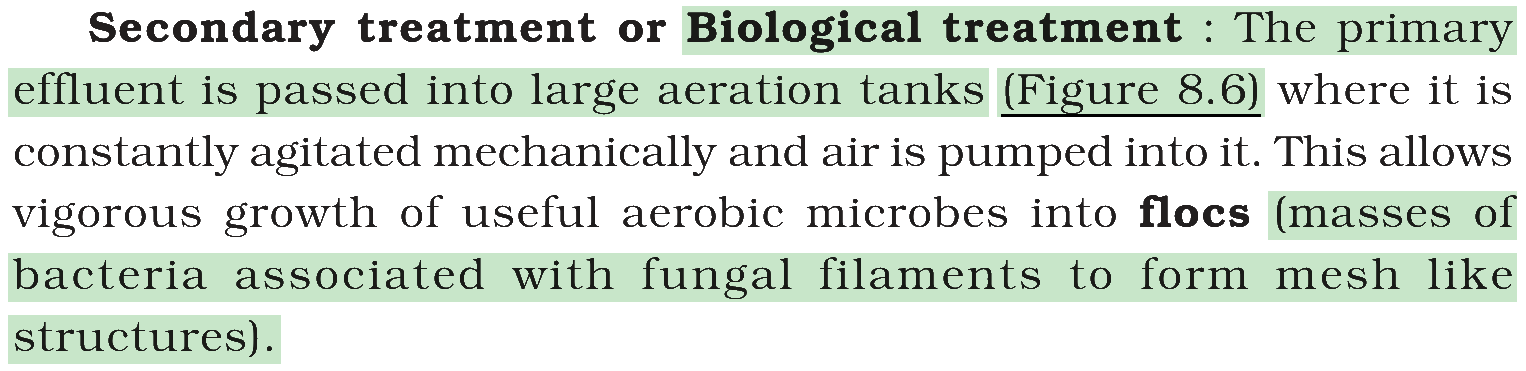
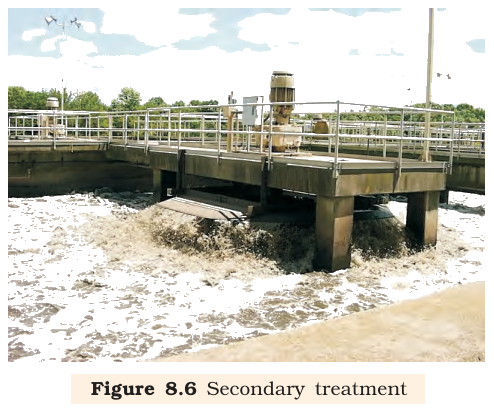
In the secondary (biological) treatment of sewage, the effluent is passed into large aeration tanks. Air is pumped in, and useful aerobic microbes grow vigorously. They form flocs, which feed on the organic matter and bring the BOD down.
(1) Masses of bacteria associated with algal filaments — Incorrect. The filaments in a floc are fungal, not algal.
(2) Masses of bacteria associated with fungal filaments — Correct. A floc is a mesh-like mass of bacteria held together with fungal filaments.
(3) Masses of algae associated with fungal filaments — Incorrect. The main members of a floc are bacteria, not algae.
(4) Masses of cyanobacteria associated with fungal filaments — Incorrect. Cyanobacteria are photosynthetic. The main members of a floc are aerobic bacteria that break down organic matter.
Note: A similar question was also asked in CUET (UG) 2024 on 15-05-2024 (Slot 1).
NCERT Extract:
Microbes in Sewage Treatment – …