
ABCD is a quadrilateral. The length of the diagonal AC is 24 cm. The sum of the perpendiculars drawn from vertices B and D on the diagonal AC is 10 cm. What is the area of the quadrilateral in cm2?
Answer & explanation
Correct answer: option 1
The correct answer is Option (1) → 120
The diagonal AC splits the quadrilateral into two triangles, ABC and ADC, with the same base AC. The perpendiculars from B and D to AC are their heights.
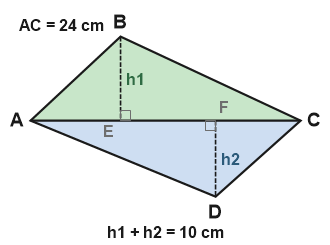
Area of ABC \(=\frac{1}{2}\times24\times h_1\)
Area of ADC \(=\frac{1}{2}\times24\times h_2\)
Area of ABCD \(=\frac{1}{2}\times24\times(h_1+h_2)=\frac{1}{2}\times24\times10=120\) cm2
Tip: The area of any quadrilateral is \(\frac{1}{2}\) × diagonal × (sum of the perpendiculars on it); the two heights need not be known separately.