
CUETMOCK
  • Pricing
  • Mentors
Log inStart freeStart free mocks→

First test, then trust

Try a free CUET mock test.

Join 5,00,000+ students who rehearsed exam day on the exact NTA screen before sitting CUET. On the web and on Android.

Start free mocks →Get the Android app
CUETMOCK

India's #1 CUET Mock Test Platform. Original NCERT-based questions on the exact NTA exam screen — trusted by 5,00,000+ students since CUET 2022.

Get it onGoogle PlayScan to download the CUETMOCK app

Mock tests

  • CUET mock test series
  • Commerce mocks
  • Humanities (Arts) mocks
  • Science mocks
  • Languages & GAT mocks
  • Free practice questions
  • Pricing

Resources

  • CUET exam guide
  • CUET syllabus
  • Universities accepting CUET
  • Expert blogs
  • News & notifications
  • Webinars & counselling
  • CUET score calculator
  • How we estimate your rank
  • FAQs

Company

  • About us
  • Our leadership & team
  • Our toppers
  • Mentors
  • For schools
  • Contact us
  • Terms
  • Privacy
  • Refund policy

Talk to us

+91 7696 6630 56info@cuetmock.comWhatsApp us

Our other platforms

  • JEE Mock — For IIT-JEE aspirants
  • NEET Mock — For NEET aspirants

Newsletter

Exam updates, study material and offers — no spam.

© 2026 NYC Ventures Pvt. Ltd.

701-702, Royal Business Park, Zirakpur, Punjab - 140603

  • Terms of use
  • Privacy policy
  • Refund policy
  • Contact us

iCUETMOCK is an independent preparation platform, not affiliated with the National Testing Agency (NTA). Always check exam details on the official NTA website.

  • Home
  • Mock tests
  • CUET guide
  • Pricing
  • Log in
Home/Practice questions/Chemistry
ChemistryOrganic: Haloalkanes and Haloarenes

Assertion (A): Fluorobenzene is not prepared from benzene by electrop…

Haloarenes undergo the usual electrophilic reactions of the benzene ring such as halogenation, nitration, sulphonation and Friedel-Crafts reactions. Halogen atom besides being slightly deactivating is o, p-directing; therefore, further substitution occurs at ortho- and para-positions with respect to the halogen atom. The o, p-directing influence of halogen atom can be easily understood if we consider the resonating structures of halobenzene as shown:
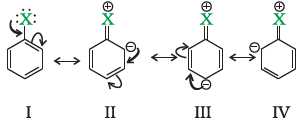
Due to resonance, the electron density increases more at ortho- and para-positions than at meta-positions. Further, the halogen atom because of its –I effect has some tendency to withdraw electrons from the benzene ring. As a result, the ring gets somewhat deactivated as compared to benzene and hence the electrophilic substitution reactions in haloarenes occur slowly and require more drastic conditions as compared to those in benzene.

Assertion (A): Fluorobenzene is not prepared from benzene by electrophilic substitution with fluorine in the presence of a Lewis acid catalyst.

Reason (R): Among the carbon–halogen bonds, the C–F bond is the shortest.

In the light of the above statements, choose the correct answer from the options given below:

Answer & explanation+

Correct answer: option 2

The correct answer is Option (2) → Both (A) and (R) are true but (R) is not the correct explanation of (A).

Assertion (A): Fluorobenzene is not prepared from benzene by electrophilic substitution with fluorine in the presence of a Lewis acid catalyst. — True. Aryl chlorides and bromides are made this way, but fluoro compounds are not prepared by this method.

Reason (R): Among the carbon–halogen bonds, the C–F bond is the shortest. — True. Fluorine is the smallest halogen atom, so the C–F bond is the shortest: 139 pm in CH3F, against 178, 193 and 214 pm for the C–Cl, C–Br and C–I bonds.

Why R does not explain A?

  • R describes the size of the C–F bond in the product; it says nothing about how fluorine behaves when it reacts with benzene.

  • The correct reason is the high reactivity of fluorine, which makes this method unsuitable for fluoro compounds.

NCERT (2026-27 edition):
6.5 Preparation of Haloarenes – “Aryl chlorides and bromides can be easily prepared by electrophilic substitution of arenes with chlorine and bromine respectively in the presence of Lewis acid catalysts like iron or iron(III) chloride.” … “Fluoro compounds are not prepared by this method due to high reactivity of fluorine.”

6.3 Nature of C-X Bond – “…Fluorine atom is the smallest and iodine atom is the largest. Consequently the carbon-halogen bond length also increases from C—F to C—I. Some typical bond lengths, bond enthalpies and dipole moments are given in Table 6.2.”

Table 6.2: Carbon-Halogen (C—X) Bond Lengths, Bond Enthalpies and Dipole Moments
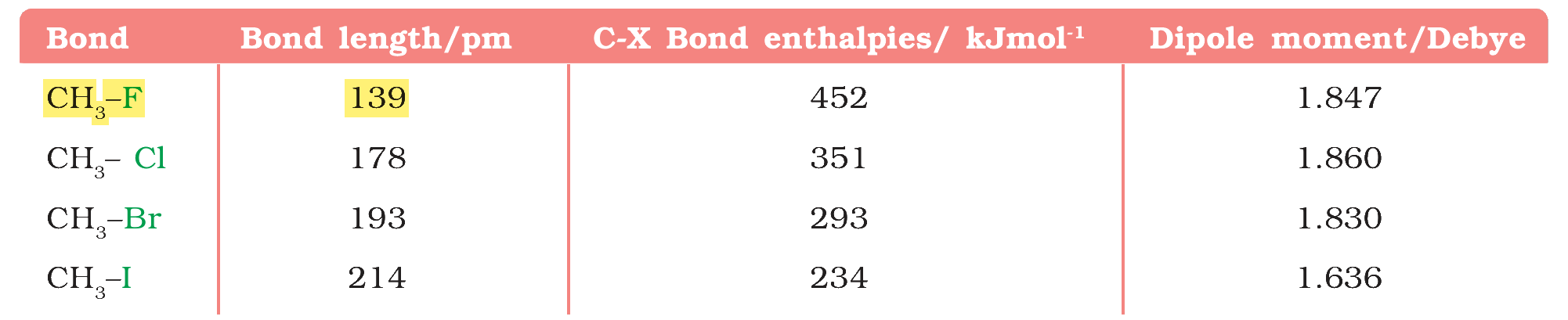
Table 6.2

Advertisement

Practise more on Organic: Haloalkanes and Haloarenes

Chapter-wise mocks on the real NTA exam screen, with solutions and your rank. Your first mocks are free.

Start free mocks →

Advertisement

Next questions

  1. ‘Her subordinates act in a desired manner to achieve organisational goals’. Which element of Directing is pointed out in this statement?Business Studies · Directing
  2. At the present level of employment in a hypothetical economy, the aggregate demand is falling short of aggregate supply. What will be the l…Economics · Macro Economics: Determination of Income and Employment
  3. Match List-I with List-IIList-IList-IIName of the geneEncodes(A) ‘i’(I) Permease(B) ‘z’(II) Repressor(C) ‘y’(III) Transacetylase(D) ‘a’(IV)…Biology · Molecular Basis of Inheritance
  4. If the matrix […] is skew-symmetric, then values of x and y are respectivelyMaths. Section B1 · Matrices
  5. The Fifteenth Finance Commission was constituted in:General Aptitude Test · General Knowledge
  6. ‘Dipavamsa’ and ‘Mahavamsa’ related to Buddhism were composed in which foreign country?History · Ancient India: Thinkers, Beliefs and Buildings
  7. cos(30° + θ) - sin(60° - θ) = ______.General Aptitude Test · Quantitative Reasoning
  8. Who followed the new direction opened by Abanindranath?1) Partha Mitter2) Kshitindranath Majumdar3) M. R. Chughtai4) Cubist artistsFine Arts · The Bengal School and Cultural Nationalism
  9. Choose the correct statements from the following: A. I is more basic than II B. II is more basic than I and III C. III is more basic than I…Chemistry · Organic: Amines
  10. The interest on capital accounts of partners under fixed capital method is to be credited to_______________Accountancy Part A · Accounting for Partnership