
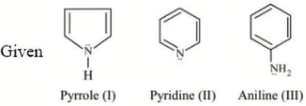
Choose the correct statements from the following:
A. I is more basic than II
B. II is more basic than I and III
C. III is more basic than II.
D. All behave as Lewis bases.
Answer & explanation
Correct answer: option 4
The correct answer is Option (4) → B and D only.
A. I is more basic than II
The statement "Pyrrole (I) is more basic than Pyridine (II)" is incorrect. In fact, pyrrole is significantly less basic than pyridine. Let us break down the reasons why:
Basicity and Availability of the Lone Pair
The basicity of a compound depends largely on the availability of its lone pair of electrons to accept protons \((H^+)\). Pyrrole is an aromatic five-membered ring with a nitrogen atom. In pyrrole, the nitrogen's lone pair is involved in maintaining the aromaticity of the ring. The lone pair is delocalized within the \(\pi \)-system of the ring, making it less available to act as a base. This delocalization is necessary to satisfy Hückel’s rule for aromaticity, making pyrrole a weak base.
Pyridine, on the other hand, is a six-membered aromatic ring where the nitrogen's lone pair is in an \(sp^2\) hybrid orbital and is not involved in the aromatic \(\pi \)-system. This lone pair is localized and free to accept protons, making pyridine much more basic than pyrrole.
Aromaticity and Electron Delocalization
In pyrrole, the nitrogen lone pair is essential for maintaining aromaticity because it is part of the conjugated \(\pi \)-electron system. If the nitrogen in pyrrole donates its lone pair (acting as a base), it disrupts the aromatic system, which is highly unfavorable.
In pyridine, the nitrogen's lone pair is not part of the aromatic \(\pi \)-system, meaning that pyridine can act as a base without losing its aromaticity. This makes pyridine a much stronger base than pyrrole.
Comparison of Basicity
Pyrrole has a pKa of its conjugate acid around 0.4, which indicates it is a very weak base. Pyridine has a pKa of its conjugate acid around 5.2, showing it is a significantly stronger base than pyrrole.
Summary
Pyrrole is less basic than pyridine because its nitrogen lone pair is delocalized in the aromatic π-system and is not available for protonation. Pyridine is more basic because its nitrogen lone pair is localized and available for protonation without disrupting aromaticity.
Therefore, the correct statement should be: Pyridine (II) is more basic than Pyrrole (I).
B. II is more basic than I and III
The statement "Pyridine (II) is more basic than Pyrrole (I) and Aniline (III)" is correct. Here’s a detailed explanation of the basicity comparison between pyridine (II), pyrrole (I), and aniline (III):
Basicity of Pyridine (II)
Pyridine is a six-membered aromatic ring with nitrogen as one of the ring atoms. In pyridine, the nitrogen's lone pair is localized in an \(sp^2\) orbital, and it is not involved in the aromatic π-electron system of the ring.
This makes the lone pair readily available to accept a proton \((H^+)\), meaning that pyridine can act as a base without losing aromaticity.
Pyridine is a moderately strong base with a pKa of its conjugate acid around 5.2, meaning it is more basic than pyrrole and aniline.
Basicity of Pyrrole (I)
Pyrrole is a five-membered aromatic ring, where the nitrogen's lone pair is delocalized into the \(\pi \)-system, helping to maintain the ring’s aromaticity.
Because the lone pair is part of the aromatic system, it is not readily available for protonation, making pyrrole a very weak base.
The \(pK_a\) of the conjugate acid of pyrrole is around 0.4, indicating that pyrrole is far less basic than pyridine.
Basicity of Aniline (III)
Aniline is an aromatic amine where the nitrogen is attached to a phenyl group \((C_6H_5-NH_2)\). In aniline, the nitrogen’s lone pair is in an \(sp^3\) orbital, but it can interact with the aromatic \(\pi \)-system of the benzene ring through resonance.
This resonance delocalization decreases the availability of the lone pair to accept a proton, thus reducing the basicity of aniline compared to aliphatic amines.
The \(pK_a\) of the conjugate acid of aniline is around 4.6, making it less basic than pyridine but more basic than pyrrole.
Basicity Comparison:
Pyridine (II): The nitrogen lone pair is not involved in the aromatic π-system, making it highly available for protonation. This makes pyridine the most basic among the three.
Aniline (III): The nitrogen’s lone pair is partially delocalized into the benzene ring through resonance, reducing its basicity compared to pyridine, but it is still more basic than pyrrole
Pyrrole (I): The nitrogen lone pair is completely delocalized in the \(\pi \)-system of the aromatic ring, making it least available for protonation. As a result, pyrrole is the least basic of the three.
Order of Basicity: Pyridine (II) > Aniline (III) > Pyrrole (I)
Summary:
Pyridine (II) is more basic than both pyrrole (I) and aniline (III) because its nitrogen’s lone pair is available for protonation.
Pyrrole (I) is the least basic due to the delocalization of the nitrogen lone pair in the aromatic system.
Aniline (III) has intermediate basicity because the lone pair is partially delocalized into the aromatic ring but not as strongly as in pyrrole.
Thus, the statement is correct: Pyridine is more basic than pyrrole and aniline.
C. III is more basic than II.
The statement "Aniline (III) is more basic than Pyridine (II)" is incorrect. In fact, pyridine is more basic than aniline. Let us go into detail about why this is the case:
Basicity of Aniline (III)
Aniline \((C_6H_5NH_2)\) is an aromatic amine where the nitrogen atom is directly attached to a benzene ring. The lone pair of electrons on the nitrogen atom in aniline can participate in resonance with the \(\pi \)-electrons of the benzene ring. This delocalization reduces the availability of the lone pair to accept a proton, thus making the nitrogen less basic. Resonance in aniline stabilizes the molecule, but it also reduces the electron density on nitrogen, decreasing its ability to act as a base. Aniline’s conjugate acid has a \(pK_a\) around 4.6, which makes it moderately basic, but less basic than pyridine.
Basicity of Pyridine (II)
Pyridine is a six-membered aromatic ring containing nitrogen. In pyridine, the nitrogen’s lone pair is in an \(sp^2\) orbital, and it is not involved in the aromatic \(\pi \)-system. Since the lone pair is localized and does not participate in resonance, it is freely available to accept a proton, making pyridine more basic than aniline. The \(pK_a\) of pyridine’s conjugate acid is around 5.2, indicating that pyridine is more basic than aniline.
Resonance and Electron Availability
In aniline, the nitrogen's lone pair is partially delocalized into the benzene ring through resonance, making it less available for protonation. In pyridine, the nitrogen’s lone pair is not involved in resonance with the ring, so it is more available to accept a proton, resulting in greater basicity.
Inductive Effect
The electron-withdrawing nature of the benzene ring in aniline also slightly reduces the electron density on nitrogen, further reducing aniline’s basicity. In contrast, the electron-withdrawing effect of the pyridine ring is less significant, allowing pyridine to retain higher basicity.
Basicity Comparison:
Pyridine (II) is more basic because its nitrogen’s lone pair is freely available for protonation.
Aniline (III) is less basic due to the delocalization of its nitrogen’s lone pair into the benzene ring, reducing the electron density and availability for protonation.
Order of Basicity: Pyridine (II) > Aniline (III)
Conclusion
The statement "Aniline (III) is more basic than Pyridine (II)" is incorrect. Pyridine is more basic than aniline due to the availability of its nitrogen’s lone pair for protonation, while aniline’s nitrogen lone pair is partially delocalized into the aromatic ring, reducing its basicity.
D. All behave as Lewis bases.
The statement that Pyrrole (I), Pyridine (II), and Aniline (III) all behave as Lewis bases is correct. All three of these compounds have a nitrogen atom with a lone pair of electrons, which can be donated to a Lewis acid, thereby behaving as Lewis bases. However, the extent of their basicity differs, but they all share the capacity to donate a lone pair, which qualifies them as Lewis bases. Let's explore how each behaves as a Lewis base:
Pyrrole (I)
Pyrrole is a five-membered heterocyclic aromatic compound in which the nitrogen atom’s lone pair is delocalized into the aromatic \(\pi \)-system, contributing to the overall stability and aromaticity of the molecule.
Lewis basicity: While pyrrole can behave as a Lewis base by donating its lone pair, this basicity is very weak because the lone pair is less available due to delocalization in the aromatic ring. Pyrrole's nitrogen lone pair is not readily available for protonation or coordination to a metal ion.
Pyridine (II)
Pyridine is a six-membered aromatic heterocyclic compound. In pyridine, the nitrogen’s lone pair is not delocalized into the \(\pi \)-system but remains in an \(sp^2\) hybrid orbital. This lone pair is free and more available to act as a Lewis base.
Lewis basicity: Pyridine is a stronger Lewis base than pyrrole because its lone pair is readily available to donate to a Lewis acid, whether it’s a proton \((H^+)\) or a metal ion. This makes pyridine a good Lewis base.
Aniline (III)
Aniline is an aromatic amine where the nitrogen is directly attached to a benzene ring. The nitrogen’s lone pair can participate in resonance with the benzene ring, but it is still available to act as a Lewis base, though its basicity is diminished compared to non-aromatic amines.
Lewis basicity: Aniline is a moderate Lewis base, with the nitrogen’s lone pair being partially delocalized into the ring but still available for donation to Lewis acids like protons or metal ions.
A Lewis base is any species that can donate an electron pair to form a covalent bond with a Lewis acid. All three molecules—pyrrole, pyridine, and aniline—have nitrogen atoms with lone pairs of electrons that can be donated to a Lewis acid. The availability of the lone pair for donation varies among the three:
Pyrrole (I): Weak Lewis base due to delocalization of the lone pair into the aromatic ring.
Pyridine (II): Stronger Lewis base as the lone pair is not delocalized and is readily available.
Aniline (III): Moderate Lewis base as the lone pair is partially delocalized into the benzene ring, reducing its availability.
Summary:
All three compounds—pyrrole, pyridine, and aniline—can act as Lewis bases because they have nitrogen atoms with lone pairs that can be donated to a Lewis acid. However, their basicity varies, with pyridine being the strongest Lewis base, followed by aniline, and pyrrole being the weakest due to the delocalization of its lone pair into the aromatic system.