
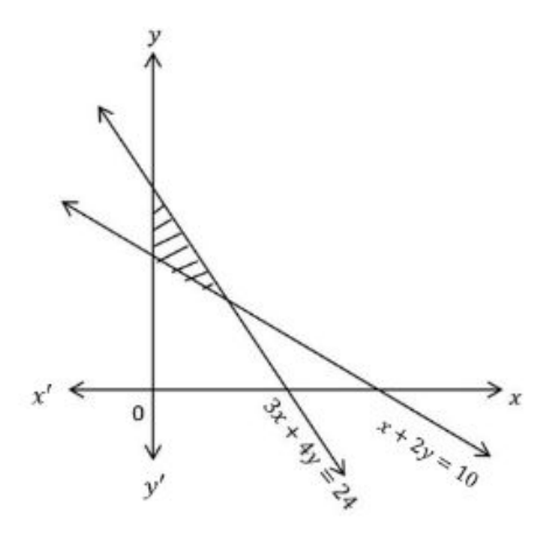
For a linear programming problem, the feasible region is shown in the figure by shaded portion, then linear constraints are
Answer & explanation
Correct answer: option 4
The correct answer is Option (4) → \(3x + 4y \le 24, x + 2y \ge 10, x \ge 0, y \ge 0\)
Intercepts of the two lines in the figure:
\(3x + 4y = 24\): (8, 0) and (0, 6)
\(x + 2y = 10\): (10, 0) and (0, 5)
They meet where \(x = 10 - 2y\):
\(3(10 - 2y) + 4y = 24\)
\(-2y = -6,\quad y = 3,\quad x = 4\)
The shaded region is the small triangle with corners (0, 5), (0, 6) and (4, 3), between the two lines and to the right of the y-axis. Each side is fixed by the origin test:
The region lies on the origin side of \(3x + 4y = 24\), and \(0 \le 24\), so \(3x + 4y \le 24\).
The region lies on the far side of \(x + 2y = 10\) from the origin, and \(0 \lt 10\), so \(x + 2y \ge 10\).
With \(x \ge 0, y \ge 0\) for the first quadrant, the constraints are \(3x + 4y \le 24\), \(x + 2y \ge 10\), \(x \ge 0\), \(y \ge 0\).