
CUETMOCK
  • Pricing
  • Mentors
Log inStart freeStart free mocks→

First test, then trust

Try a free CUET mock test.

Join 5,00,000+ students who rehearsed exam day on the exact NTA screen before sitting CUET. On the web and on Android.

Start free mocks →Get the Android app
CUETMOCK

India's #1 CUET Mock Test Platform. Original NCERT-based questions on the exact NTA exam screen — trusted by 5,00,000+ students since CUET 2022.

Get it onGoogle PlayScan to download the CUETMOCK app

Mock tests

  • CUET mock test series
  • Commerce mocks
  • Humanities (Arts) mocks
  • Science mocks
  • Languages & GAT mocks
  • Free practice questions
  • Pricing

Resources

  • CUET exam guide
  • CUET syllabus
  • Universities accepting CUET
  • Expert blogs
  • News & notifications
  • Webinars & counselling
  • CUET score calculator
  • How we estimate your rank
  • FAQs

Company

  • About us
  • Our leadership & team
  • Our toppers
  • Mentors
  • For schools
  • Contact us
  • Terms
  • Privacy
  • Refund policy

Talk to us

+91 7696 6630 56info@cuetmock.comWhatsApp us

Our other platforms

  • JEE Mock — For IIT-JEE aspirants
  • NEET Mock — For NEET aspirants

Newsletter

Exam updates, study material and offers — no spam.

© 2026 NYC Ventures Pvt. Ltd.

701-702, Royal Business Park, Zirakpur, Punjab - 140603

  • Terms of use
  • Privacy policy
  • Refund policy
  • Contact us

iCUETMOCK is an independent preparation platform, not affiliated with the National Testing Agency (NTA). Always check exam details on the official NTA website.

  • Home
  • Mock tests
  • CUET guide
  • Pricing
  • Log in
Home/Practice questions/Chemistry
ChemistryInorganic: Coordination Compounds

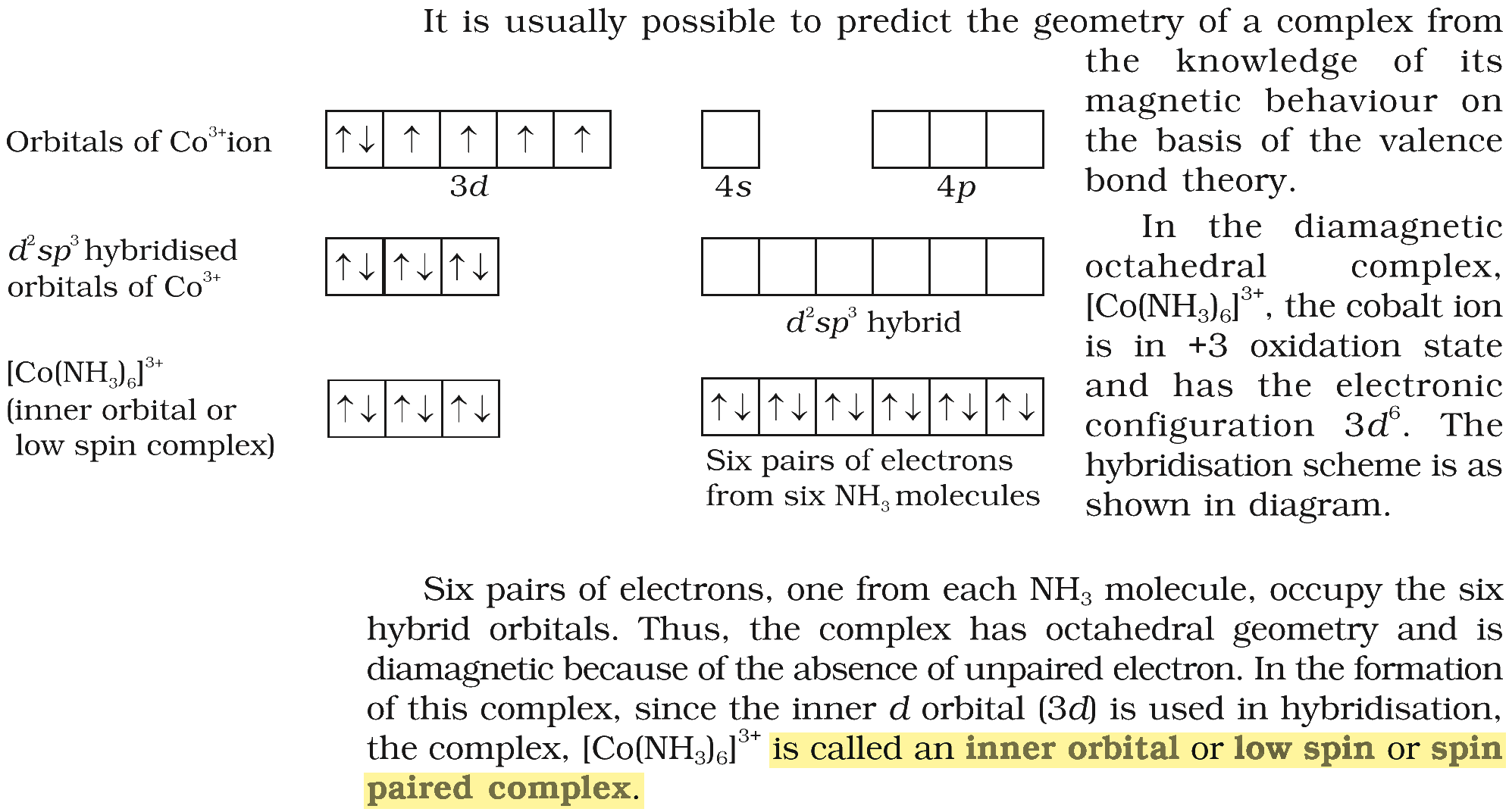
What is the hybridization of [Co(NH3)6]3+ ?

Coordination Compounds

Alfred Werner (1866-1919), a Swiss chemist was the first to formulate his ideas about the structures of coordination compounds. He prepared and characterised a large number of coordination compounds and studied their physical and chemical behaviour by simple experimental techniques. Werner proposed the concept of a primary valence and a secondary valence for a metal ion. The formulas and names adopted for coordination entities are based on the recommendations of the International Union of Pure and Applied Chemistry (IUPAC). Many approaches have been put forth to explain the nature of bonding in coordination compounds viz. Valence Bond Theory (VBT), Crystal Field Theory (CFT), Ligand Field Theory (LFT) and Molecular Orbital Theory (MOT). The Valence Bond Theory (VBT) explains with reasonable success, the formation, magnetic behaviour and geometrical shapes of coordination compounds. It, however, fails to provide a quantitative interpretation of magnetic behaviour and has nothing to say about the optical properties of these compounds. The Crystal Field Theory (CFT) to coordination compounds is based on the effect of different crystal fields (provided by the ligands taken as point charges), on the degeneracy of d orbital energies of the central metal atom/ion. The splitting of the d orbitals provides different electronic arrangements in strong and weak crystal fields. The treatment provides for quantitative estimations of orbital separation energies, magnetic moments and spectral and stability parameters. However, the assumption that ligands constitute point charges creates many theoretical difficulties.

What is the hybridization of [Co(NH3)6]3+ ?

Answer & explanation+

Correct answer: option 3

The correct answer is Option (3) → d2sp3

By valence bond theory, the metal ion uses a set of hybrid orbitals to accept one lone pair from each ligand. For six ligands (octahedral), two d orbitals are needed:

  • d2sp3 (inner orbital complex): uses the inner (n−1)d orbitals. This is possible when the d electrons pair up and leave two inner d orbitals empty; the complex is usually low spin.

  • sp3d2 (outer orbital complex): uses the outer nd orbitals, so the inner d electrons stay unpaired; the complex is high spin.

In \( \ce{[Co(NH3)6]^{3+}} \), cobalt is in the +3 state:

    \( \displaystyle \ce{Co}\ (Z=27):\ [\ce{Ar}]\,3d^{7}\,4s^{2} \)

    \( \displaystyle \ce{Co^3+}:\ [\ce{Ar}]\,3d^{6} \)

\( \ce{NH3} \) pairs the six 3d electrons, leaving two inner 3d orbitals free, so the complex is an inner orbital, diamagnetic octahedral complex.

So the hybridisation of \( \ce{[Co(NH3)6]^{3+}} \) is d2sp3.

Why the other options are incorrect

  • Option (1) sp3d3 — Incorrect. It needs seven orbitals and gives a pentagonal bipyramid (as in \( \ce{IF7} \)), not six-coordination.

  • Option (2) sp3d2 — Incorrect. This outer orbital hybridisation is found in \( \ce{[CoF6]^{3-}} \), where the 3d electrons stay unpaired (4 unpaired electrons, paramagnetic).

  • Option (4) sp3d — Incorrect. It uses five orbitals and gives a trigonal bipyramid, which fits five ligands, not six.

NCERT (2026-27 edition):
Valence Bond Theory – …
Textbook extract

Advertisement

Practise more on Inorganic: Coordination Compounds

Chapter-wise mocks on the real NTA exam screen, with solutions and your rank. Your first mocks are free.

Start free mocks →

Advertisement

Next questions

  1. What was a characteristic of non-democratic rule in many newly independent post-colonial countries?Political Science · Politics in India Since Independence: Era of one Party Dominance
  2. How many 7s immediately preceded by 6 but not immediately followed by 4 are there in the following series?7, 4, 2, 7, 6, 4, 3, 6, 7, 5, 3,…General Aptitude Test · Verbal Reasoning
  3. Match List-I with List-IIList-IList-II(A)Constant returns to scale(I)When a proportional increase in all inputs results in an increase in o…Economics · Micro Economics: Production and Costs
  4. The correct increasing order of boiling points of the following compounds is:(A) n-C4H9NH2(B) (C2H5)2NH(C) n-C4H9OH(D) C2H5N(CH3)2Choose th…Chemistry · Organic: Amines
  5. The final structure of amine produced by Hofmann degradation of m-bromobenzamide isChemistry · Organic: Amines
  6. Consider the value of an investment in the given years. (Given (1.518)^1/3=1.149 )1 Jan 20201 Jan 20211 Jan 20221 Jan 2023Rs. 10000Rs. 1200…Applied Maths. Section B2 · Financial Mathematics
  7. A silicon p-n junction diode is forward biased by a 2 V battery connected through a series resistor of 10 Ω. The current through the diode…Physics · Semiconductors and Electronic Devices
  8. A closed box with a square base and vertical sides is to hold 2000 cm3. The material for the top and the bottom costs Rs. 3 per cm2 and the…Maths. Section B1 · Applications of Derivatives
  9. Amrita unknowingly has followed the organizing process. Select the correct sequence of the process.A. Assignment of dutiesB. Establishing r…Business Studies · Principles of Management
  10. Identify the ‘three’ parties mentioned in the above passage:History · Modern India: Mahatma Gandhi and the Nationalist movement