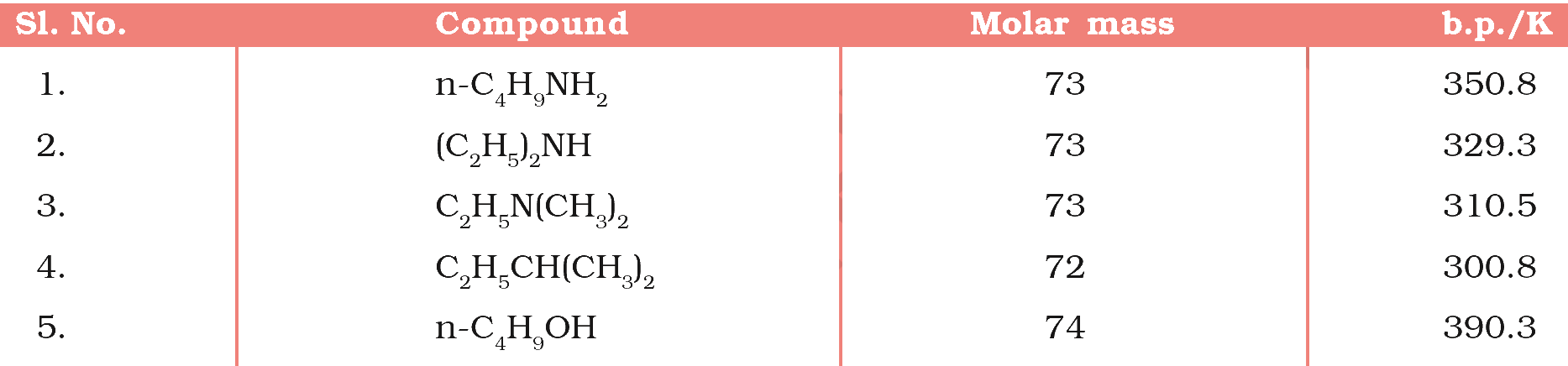
The correct increasing order of boiling points of the following compounds is:
(A) n-C4H9NH2
(B) (C2H5)2NH
(C) n-C4H9OH
(D) C2H5N(CH3)2
Choose the correct answer from the options given below:
Answer & explanation
Correct answer: option 2
The correct answer is Option (2) → (D), (B), (A), (C)
For molecules of about the same molar mass, the boiling point depends on the strength of intermolecular hydrogen bonding:
Alcohols vs amines: oxygen is more electronegative than nitrogen, so the O–H bond is more polar than the N–H bond. Alcohols therefore form stronger hydrogen bonds and boil higher than amines of similar mass.
Primary vs secondary vs tertiary amines: a primary amine has two hydrogen atoms on nitrogen, a secondary amine has one, and a tertiary amine has none. So the extent of hydrogen bonding is 1° > 2°, and tertiary amines cannot form hydrogen bonds among themselves at all.
All four compounds here have nearly the same molar mass (73–74 g mol−1), so the combined order of boiling points is:
Matching the given compounds:
(D) \( \ce{C2H5N(CH3)2} \): N,N-dimethylethanamine (3°), no N–H bond
(B) \( \ce{(C2H5)2NH} \): N-ethylethanamine (2°), one N–H bond
(A) n-\( \ce{C4H9NH2} \): butan-1-amine (1°), two N–H bonds
(C) n-\( \ce{C4H9OH} \): butan-1-ol (alcohol), the more polar O–H bond
Shortcut: The tertiary amine (D) has no N–H bond and boils lowest, while the alcohol (C) boils highest. Only Option (2) starts with (D) and ends with (C).
Note: It seems that there is a mistake in the original NTA paper. Option (2) and Option (4) were both printed as (D), (B), (A), (C), so the correct order appeared twice, and NTA accepted both options in the Final Answer Key. For students’ benefit and to ensure a single answer, Option (4) has been changed here to (B), (D), (A), (C).
NCERT (2026-27 edition):
Physical Properties – …