
CUETMOCK
  • Pricing
  • Mentors
Log inStart freeStart free mocks→

First test, then trust

Try a free CUET mock test.

Join 5,00,000+ students who rehearsed exam day on the exact NTA screen before sitting CUET. On the web and on Android.

Start free mocks →Get the Android app
CUETMOCK

India's #1 CUET Mock Test Platform. Original NCERT-based questions on the exact NTA exam screen — trusted by 5,00,000+ students since CUET 2022.

Get it onGoogle PlayScan to download the CUETMOCK app

Mock tests

  • CUET mock test series
  • Commerce mocks
  • Humanities (Arts) mocks
  • Science mocks
  • Languages & GAT mocks
  • Free practice questions
  • Pricing

Resources

  • CUET exam guide
  • CUET syllabus
  • Universities accepting CUET
  • Expert blogs
  • News & notifications
  • Webinars & counselling
  • CUET score calculator
  • How we estimate your rank
  • FAQs

Company

  • About us
  • Our leadership & team
  • Our toppers
  • Mentors
  • For schools
  • Contact us
  • Terms
  • Privacy
  • Refund policy

Talk to us

+91 7696 6630 56info@cuetmock.comWhatsApp us

Our other platforms

  • JEE Mock — For IIT-JEE aspirants
  • NEET Mock — For NEET aspirants

Newsletter

Exam updates, study material and offers — no spam.

© 2026 NYC Ventures Pvt. Ltd.

701-702, Royal Business Park, Zirakpur, Punjab - 140603

  • Terms of use
  • Privacy policy
  • Refund policy
  • Contact us

iCUETMOCK is an independent preparation platform, not affiliated with the National Testing Agency (NTA). Always check exam details on the official NTA website.

  • Home
  • Mock tests
  • CUET guide
  • Pricing
  • Log in
Home/Practice questions/Chemistry
ChemistryOrganic: Amines

Which of the following is not associated with the coupling reaction o…

Which of the following is not associated with the coupling reaction of benzene diazonium chloride?

Answer & explanation+

Correct answer: option 3

The correct answer is Option (3) → Phenol produces yellow dye in coupling reaction.

In a coupling reaction, the benzene diazonium ion acts as a weak electrophile and attacks the para position of a strongly activated ring (phenol or aniline). The two rings are joined by an –N=N– (azo) group. These azo compounds have an extended conjugated system, so they are coloured and used as dyes.

  • With phenol (in basic medium, where phenol is present as the more reactive phenoxide ion): p-hydroxyazobenzene, an orange dye.

        \( \displaystyle \ce{C6H5N2^+Cl^- + C6H5OH + OH^- -> C6H5N=N-C6H4OH + Cl^- + H2O} \)

  • With aniline (in mildly acidic medium): p-aminoazobenzene, a yellow dye.

        \( \displaystyle \ce{C6H5N2^+Cl^- + C6H5NH2} \xrightarrow{\ce{H^+}} \ce{C6H5N=N-C6H4NH2 + HCl} \)

  • Option (1) Phenol in basic condition undergoes coupling reaction. — Associated with the coupling reaction. In alkali, phenol forms the phenoxide ion, whose ring is strongly activated for attack by the diazonium ion.

  • Option (2) Aniline in acidic condition undergoes coupling reaction. — Associated with the coupling reaction. Coupling with aniline is done in a mildly acidic medium.

  • Option (3) Phenol produces yellow dye in coupling reaction. — Not associated with the coupling reaction. Phenol gives p-hydroxyazobenzene, an orange dye, not a yellow one.

  • Option (4) Aniline produces p-aminoazobenzene. — Associated with the coupling reaction. The diazonium ion attacks the para position of aniline, giving the yellow dye p-aminoazobenzene.

NCERT (2026-27 edition):
Reactions Involving Retention of Diazo Group
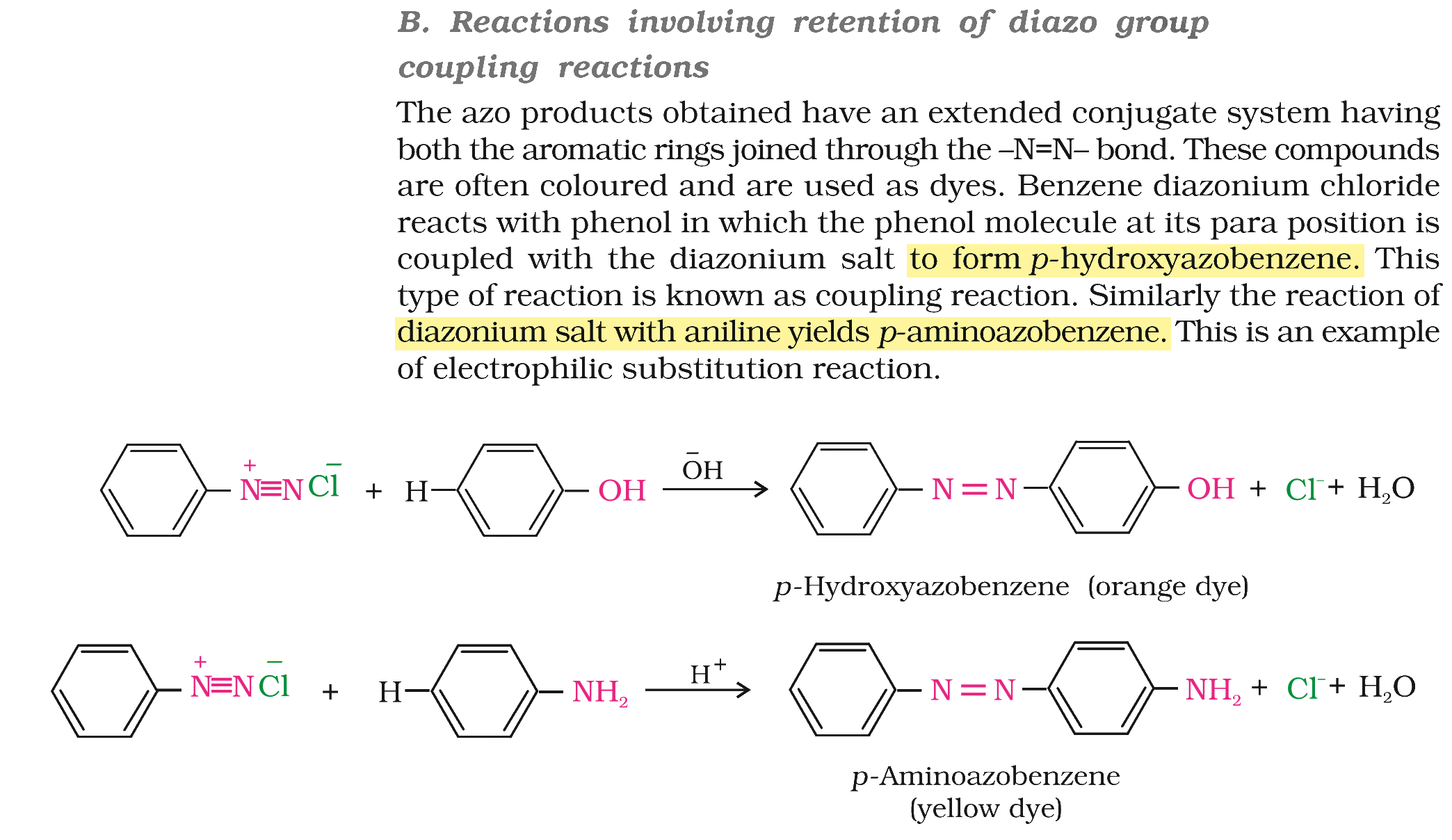
Textbook extract

Advertisement

Practise more on Organic: Amines

Chapter-wise mocks on the real NTA exam screen, with solutions and your rank. Your first mocks are free.

Start free mocks →

Advertisement

Next questions

  1. Which of the following pairs is correctly matched? List-IList-II1. Average propensity to consumeA. Change in consumption per unit change in…Economics · Macro Economics: Determination of Income and Employment
  2. A historian studying early inscriptions lists the problems she faces with this kind of evidence. Which of the following is NOT a limitation…History · Ancient India: Kings, Farmers and Towns
  3. A person covers first 25 km in 60 minutes and next 38 km in 30 minutes. What is the average speed for the whole journey?General Aptitude Test · Numerical Ability
  4. The sequence of decay of a radioactive nucleus is:If nucleon number and atomic number of R are 176 and 71 respectively. What are their valu…Physics · Nuclei
  5. The rate of biomass production is expressed in terms of ____________ to compare the productivity of different ecosystems.Biology · Ecosystem
  6. Differential equation associated with primitive y = Ae3x + Be5x :Maths. Section A · Differential Equations
  7. In the introduction to the chapter 'Globalisation and Social Change', which of the following pairs is correctly matched?Sociology · Social Change and Development in India: Globalisation and Social Change
  8. The Harappan site of Surkotada is located in which of the following regions?General Aptitude Test · General Knowledge
  9. The India-Pakistan Indus Waters Treaty was signed by Nehru and ______ in 1960.Political Science · Politics in India Since Independence: India's External Relations
  10. What was one of the primary motives of the colonial government behind the policy of de-industrialising India?Economics · Indian Economic Development: Indian Economy on the Eve of Independence