
CUETMOCK
  • Pricing
  • Mentors
Log inStart freeStart free mocks→

First test, then trust

Try a free CUET mock test.

Join 5,00,000+ students who rehearsed exam day on the exact NTA screen before sitting CUET. On the web and on Android.

Start free mocks →Get the Android app
CUETMOCK

India's #1 CUET Mock Test Platform. Original NCERT-based questions on the exact NTA exam screen — trusted by 5,00,000+ students since CUET 2022.

Get it onGoogle PlayScan to download the CUETMOCK app

Mock tests

  • CUET mock test series
  • Browse all papers
  • Commerce mocks
  • Humanities (Arts) mocks
  • Science mocks
  • Languages & GAT mocks
  • Free practice questions
  • Pricing

Resources

  • CUET exam guide
  • CUET syllabus
  • Universities accepting CUET
  • Expert blogs
  • News & notifications
  • Webinars & counselling
  • CUET score calculator
  • How we estimate your rank
  • FAQs

Company

  • About us
  • Our leadership & team
  • Our toppers
  • Mentors
  • For schools
  • Contact us
  • Terms
  • Privacy
  • Refund policy

Talk to us

+91 7696 6630 56info@cuetmock.comWhatsApp us

Our other platforms

  • JEE Mock — For IIT-JEE aspirants
  • NEET Mock — For NEET aspirants

Newsletter

Exam updates, study material and offers — no spam.

© 2026 NYC Ventures Pvt. Ltd.

701-702, Royal Business Park, Zirakpur, Punjab - 140603

  • Terms of use
  • Privacy policy
  • Refund policy
  • Contact us

iCUETMOCK is an independent preparation platform, not affiliated with the National Testing Agency (NTA). Always check exam details on the official NTA website.

  • Home
  • Mock tests
  • CUET guide
  • Pricing
  • Log in
Home/Practice questions/Fine Arts
Fine ArtsThe Modern Indian Art

Who is the artist of the shown piece of art?

Look at the image and  answer the following question:
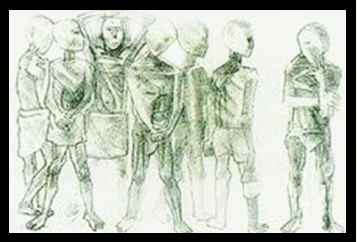
Who is the artist of the shown piece of art?

Answer & explanation+

Correct answer: option 4

The correct answer is Option 4:  Somnath Hore

NCERT: Children- This is a graphic print on paper done with monochromatic etching with aquatint made by Somnath Hore (1921–2006) in 1958. The experience of the Bengal Famine of 1943, left a lasting impression on him. His early sketches and drawings were spot and life drawings of hapless victims of the famine, suffering and dying peasants, sick and infirm destitute, and portraits of men, women, children and animals. These line drawings, which followed representational contours and tonal devices, were seldom adopted. In this etching, images of children were taken from the experience of the famine of 1943, which was etched in his memory. This is a close-knit composition with five standing figures, having no background, perspective or surrounding situation as the figures are talking to themselves. The figures are linear, each with a skeletal torso of a huge malaria spleen and ribcage for the thorax. Supporting a huge skull, with a small face, the whole body is seen resting on two stick-like legs. Strong definitional lines of straight linear gestures, which etched each rib of the thorax and each cheekbone, appears as deep gashing wounds. The bone structure just beneath the skin renders the effect of malnutrition on the people. It creates narrative quality in the picture without taking recourse to placing the figures in a situation of supporting visual data, following reductionist and simplification method. These children represent the most vulnerable section of the society. Somanth Hore’s some other artworks include Peasants’ Meeting, Wounded Animal, The Child, Mother with Child, Mourners and the Unclad Beggar Family.

Advertisement

Practise more on The Modern Indian Art

Chapter-wise mocks on the real NTA exam screen, with solutions and your rank. Your first mocks are free.

Start free mocks →

Advertisement

Next questions

  1. Which of the following statements are correct about European Union? (A) The end of the Second World War posed the 'Question of Europe'.(B)…Political Science · Contemporary World Politics: Contemporary Centres of power
  2. Select a figure from options which will continue the same series established by the five problem figures.Problem FigureGeneral Aptitude Test · Non-Verbal Reasoning
  3. Name the physicist who is credited with the discovery of the Neutron. This 1932 discovery led to his winning the Nobel Prize.General Aptitude Test · General Knowledge
  4. Three cards are drawn simultaneously from a well shuffled pack of cards. Find the probability of all the three being Honor cards.General Aptitude Test · Quantitative Reasoning
  5. The sensitivity of a moving coil galvanometer can be increased by decreasingPhysics · Moving Charges and Magnetism
  6. When Ram brought old newspapers and made a bowl out of it with the help of paper mache art, what do you think which basic economic activity…Economics · Macro Economics: National Income Accounting
  7. The Indian Government has levied windfall profit tax in 2022 on which of the following item(s)?General Aptitude Test · General Knowledge
  8. When were separate electorates created for the Muslims in India for the first time at the national level?History · Modern India: Understanding Partition
  9. Which of the following statements about Tiller of the Soil, one of Nandalal Bose’s Haripura panels, is NOT correct?Fine Arts · The Bengal School and Cultural Nationalism
  10. GAINEnglish · Antonyms