
CUETMOCK
  • Pricing
  • Mentors
Log inStart freeStart free mocks→

First test, then trust

Try a free CUET mock test.

Join 5,00,000+ students who rehearsed exam day on the exact NTA screen before sitting CUET. On the web and on Android.

Start free mocks →Get the Android app
CUETMOCK

India's #1 CUET Mock Test Platform. Original NCERT-based questions on the exact NTA exam screen — trusted by 5,00,000+ students since CUET 2022.

Get it onGoogle PlayScan to download the CUETMOCK app

Mock tests

  • CUET mock test series
  • Browse all papers
  • Commerce mocks
  • Humanities (Arts) mocks
  • Science mocks
  • Languages & GAT mocks
  • Free practice questions
  • Pricing

Resources

  • CUET exam guide
  • CUET syllabus
  • Universities accepting CUET
  • Expert blogs
  • News & notifications
  • Webinars & counselling
  • CUET score calculator
  • How we estimate your rank
  • FAQs

Company

  • About us
  • Our leadership & team
  • Our toppers
  • Mentors
  • For schools
  • Contact us
  • Terms
  • Privacy
  • Refund policy

Talk to us

+91 7696 6630 56info@cuetmock.comWhatsApp us

Our other platforms

  • JEE Mock — For IIT-JEE aspirants
  • NEET Mock — For NEET aspirants

Newsletter

Exam updates, study material and offers — no spam.

© 2026 NYC Ventures Pvt. Ltd.

701-702, Royal Business Park, Zirakpur, Punjab - 140603

  • Terms of use
  • Privacy policy
  • Refund policy
  • Contact us

iCUETMOCK is an independent preparation platform, not affiliated with the National Testing Agency (NTA). Always check exam details on the official NTA website.

  • Home
  • Mock tests
  • CUET guide
  • Pricing
  • Log in
Home/Practice questions/General Aptitude Test
General Aptitude TestNon-Verbal ReasoningFigure Series

Select a figure from options which will continue the same series esta…

Select a figure from options which will continue the same series established by the five problem figures.

Problem Figure

Answer & explanation+

Correct answer: option 2

The correct answer is Option (2) → 
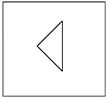
Option 2

The figures go in pairs: a dotted line marks a cut, and in the next figure the part on the left of the cut is gone (the pointed end of the first figure, then the upper-left half of the square). In the fifth figure the dotted line runs from the middle of the slanting side to the right-angled corner, so the left part drops and the right-hand triangle is left, with its upright side on the right and its point at the middle of the old slanting side.

Advertisement

Practise more on Non-Verbal Reasoning

Chapter-wise mocks on the real NTA exam screen, with solutions and your rank. Your first mocks are free.

Start free mocks →

Advertisement

Next questions

  1. Name the physicist who is credited with the discovery of the Neutron. This 1932 discovery led to his winning the Nobel Prize.General Aptitude Test · General Knowledge
  2. Three cards are drawn simultaneously from a well shuffled pack of cards. Find the probability of all the three being Honor cards.General Aptitude Test · Quantitative Reasoning
  3. The sensitivity of a moving coil galvanometer can be increased by decreasingPhysics · Moving Charges and Magnetism
  4. When Ram brought old newspapers and made a bowl out of it with the help of paper mache art, what do you think which basic economic activity…Economics · Macro Economics: National Income Accounting
  5. The Indian Government has levied windfall profit tax in 2022 on which of the following item(s)?General Aptitude Test · General Knowledge
  6. When were separate electorates created for the Muslims in India for the first time at the national level?History · Modern India: Understanding Partition
  7. Which of the following statements about Tiller of the Soil, one of Nandalal Bose’s Haripura panels, is NOT correct?Fine Arts · The Bengal School and Cultural Nationalism
  8. GAINEnglish · Antonyms
  9. Which of the following is an ancient theory of abnormal behaviour that is still encountered today?Psychology · Psychological Disorders
  10. Let f(x)=≤ft […] .. Which one of the following statements is correct ?Maths. Section B1 · Continuity and Differentiability