Statement I: Zinc displaces copper from copper sulphate solution.
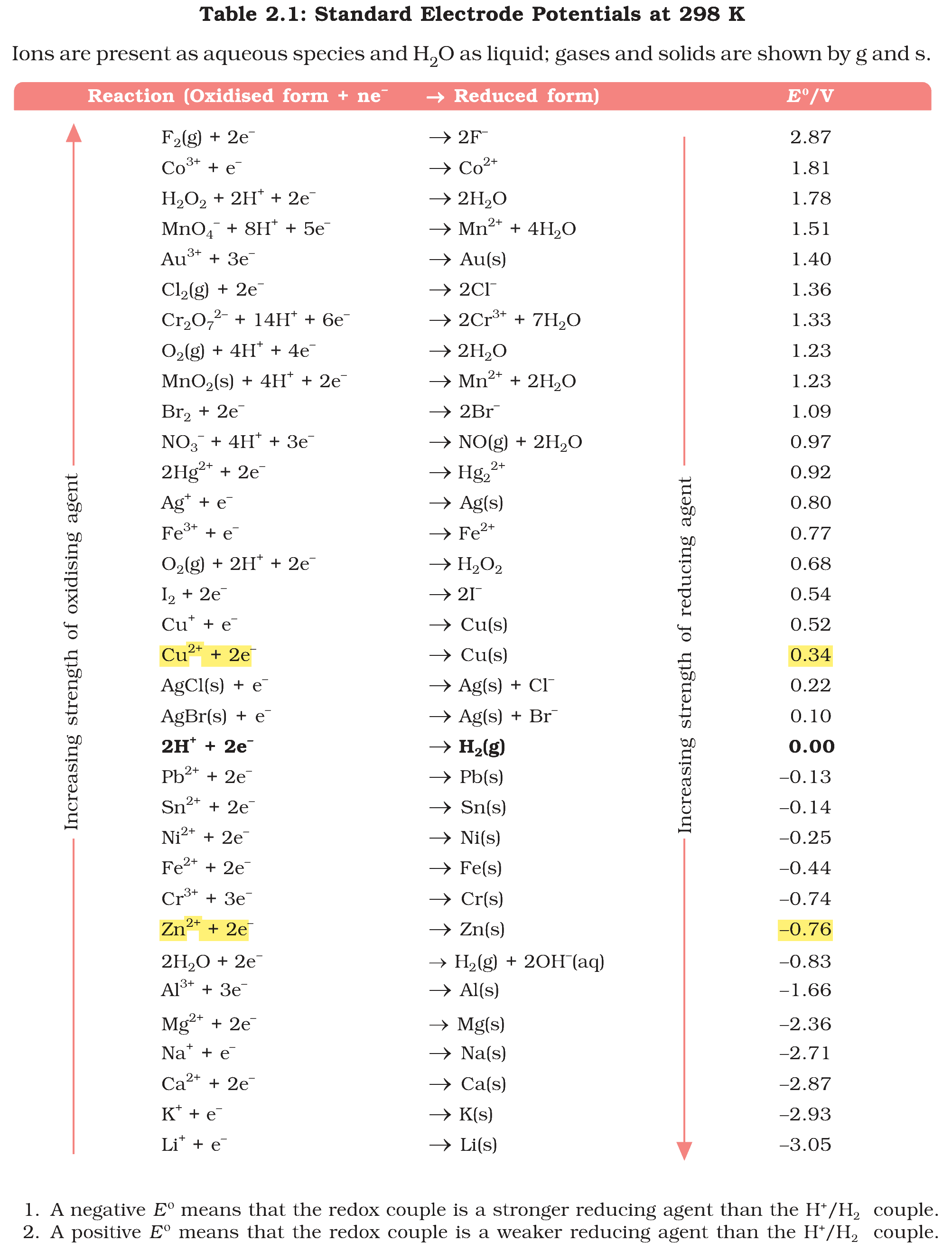
Statement II: The standard electrode potential (E°) of Zn2+/Zn is −0.76 V and that of Cu2+/Cu is +0.34 V.
Answer & explanation
Correct answer: option 1
The correct answer is Option (1) → Both Statement I and Statement II are correct and Statement II is the correct explanation of Statement I.
The lower the standard electrode potential of a couple, the stronger its metal is as a reducing agent. A metal reduces the ions of a metal whose E° is higher.
Statement I: Zinc displaces copper from copper sulphate solution. — True. Zinc is oxidised and the copper ions are reduced to copper metal; this is the spontaneous redox reaction of the Daniell cell:
\( \displaystyle \ce{Zn(s) + Cu^2+(aq) -> Zn^2+(aq) + Cu(s)} \)
Statement II: The standard electrode potential (E°) of Zn2+/Zn is −0.76 V and that of Cu2+/Cu is +0.34 V. — True. These are the values in the table of standard electrode potentials at 298 K.
Why Statement II explains Statement I? E° of \( \ce{Zn^2+/Zn} \) (−0.76 V) is lower than that of \( \ce{Cu^2+/Cu} \) (+0.34 V), so zinc is the stronger reducing agent and gives its electrons to \( \ce{Cu^2+} \). For this reaction E°cell = 0.34 − (−0.76) = 1.10 V, a positive value, so the displacement takes place on its own.
NCERT (2026-27 edition):
2.2 Galvanic Cells – “As mentioned earlier a galvanic cell is an electrochemical cell that converts the chemical energy of a spontaneous redox reaction into electrical energy. … Daniell cell discussed earlier is one such cell in which the following redox reaction occurs.”
\( \displaystyle \ce{Zn(s) + Cu^2+(aq) -> Zn^2+(aq) + Cu(s)} \)
2.2.1 Measurement of Electrode Potential – “… It may be seen that as we go from top to bottom in Table 2.1 the standard electrode potential decreases and with this, decreases the oxidising power of the species on the left and increases the reducing power of the species on the right hand side of the reaction.”
Table 2.1: Standard Electrode Potentials at 298 K