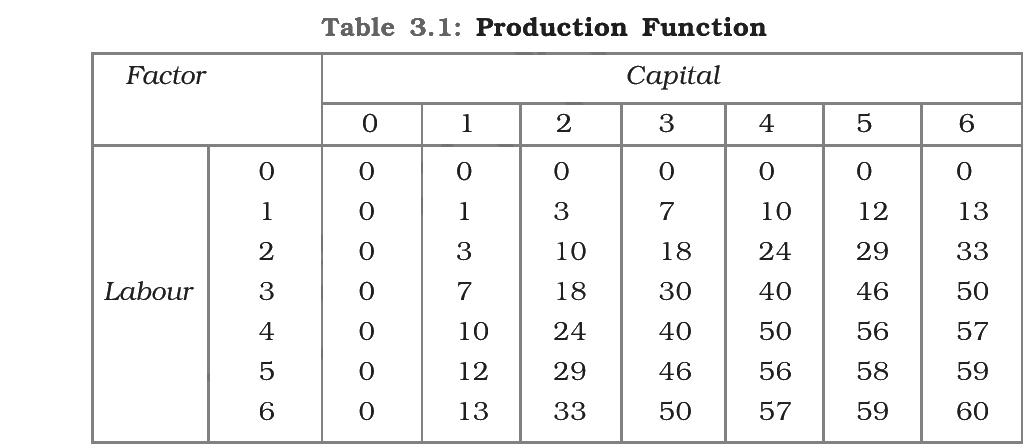
Study the following production function (output in units):
| Labour (L) / Capital (K) | 0 | 1 | 2 | 3 | 4 | 5 | 6 |
|---|---|---|---|---|---|---|---|
| 0 | 0 | 0 | 0 | 0 | 0 | 0 | 0 |
| 1 | 0 | 1 | 3 | 7 | 10 | 12 | 13 |
| 2 | 0 | 3 | 10 | 18 | 24 | 29 | 33 |
| 3 | 0 | 7 | 18 | 30 | 40 | 46 | 50 |
| 4 | 0 | 10 | 24 | 40 | 50 | 56 | 57 |
| 5 | 0 | 12 | 29 | 46 | 56 | 58 | 59 |
| 6 | 0 | 13 | 33 | 50 | 57 | 59 | 60 |
A firm uses 3 units of labour and 4 units of capital. It gives up 1 unit of capital. How many more units of labour does it need to stay on the same isoquant?
Answer & explanation
Correct answer: option 3
The correct answer is Option (3) → 1 unit
Given:
L = 3, K = 4 gives output 40
Capital falls to K = 3
To stay on the same isoquant, output must stay at 40.
In the K = 3 column, output 40 is in the row L = 4.
\( \displaystyle \text{Extra labour} = 4 - 3 = 1 \text{ unit} \)
With less capital, the same output needs more labour; that is why an isoquant slopes downward.
NCERT (2026-27): “Isoquant … If we fix capital at K1 and increase labour to L3, output increases and we reach a higher isoquant, q = q2. When marginal products are positive, with greater amount of one input, the same level of output can be produced only using lesser amount of the other. Therefore, isoquants are negatively sloped.”
|