
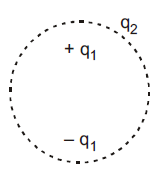
Consider the charge configuration and the spherical Gaussian surface shown in the figure. While calculating the flux of the electric field over the spherical surface, the electric field is due to
Answer & explanation
Correct answer: option 3
The correct answer is Option (3) → all the charges
Gauss’s law links the flux through a closed surface with the charge enclosed by it. The field used for the flux is the actual field at each point of the surface. Every charge, inside or outside, adds its own field there.
Option (1) \( q_2 \) — Incorrect. The charge \( q_2 \) lies outside the surface, but it is not the only source. The charges \( +q_1 \) and \( -q_1 \) inside also set up a field on the surface.
Option (2) only the positive charges — Incorrect. The negative charge \( -q_1 \) also produces a field at every point of the surface. The field does not come from positive charges alone.
Option (3) all the charges — Correct. The field at each point of the surface is the vector sum of the fields of \( +q_1 \), \( -q_1 \) and \( q_2 \).
Option (4) \( +q_1 \) and \( -q_1 \) — Incorrect. Only the enclosed charges \( +q_1 \) and \( -q_1 \) decide the net flux. The field itself also includes the field of \( q_2 \) outside.
NCERT (2026-27):
Gauss’s Law – “(iii) In the situation when the surface is so chosen that there are some charges inside and some outside, the electric field … is due to all the charges, both inside and outside S. The term q on the right side of Gauss’s law, however, represents only the total charge inside S.”