Match List I with List II
| LIST I | LIST II | ||
| A. | The autokinetic effect | I. | Cooperation and competition conformity |
| B. | Milgram's experiment | II. | Conformity |
| C. | Sherif's experiment | III. | Obedience |
| D. | Latane | IV. | Social loafing |
Choose the correct answer from the options given below:
Answer & explanation
Correct answer: option 2
The correct answer is Option (2) → A-II, B-III, C-I, D-IV
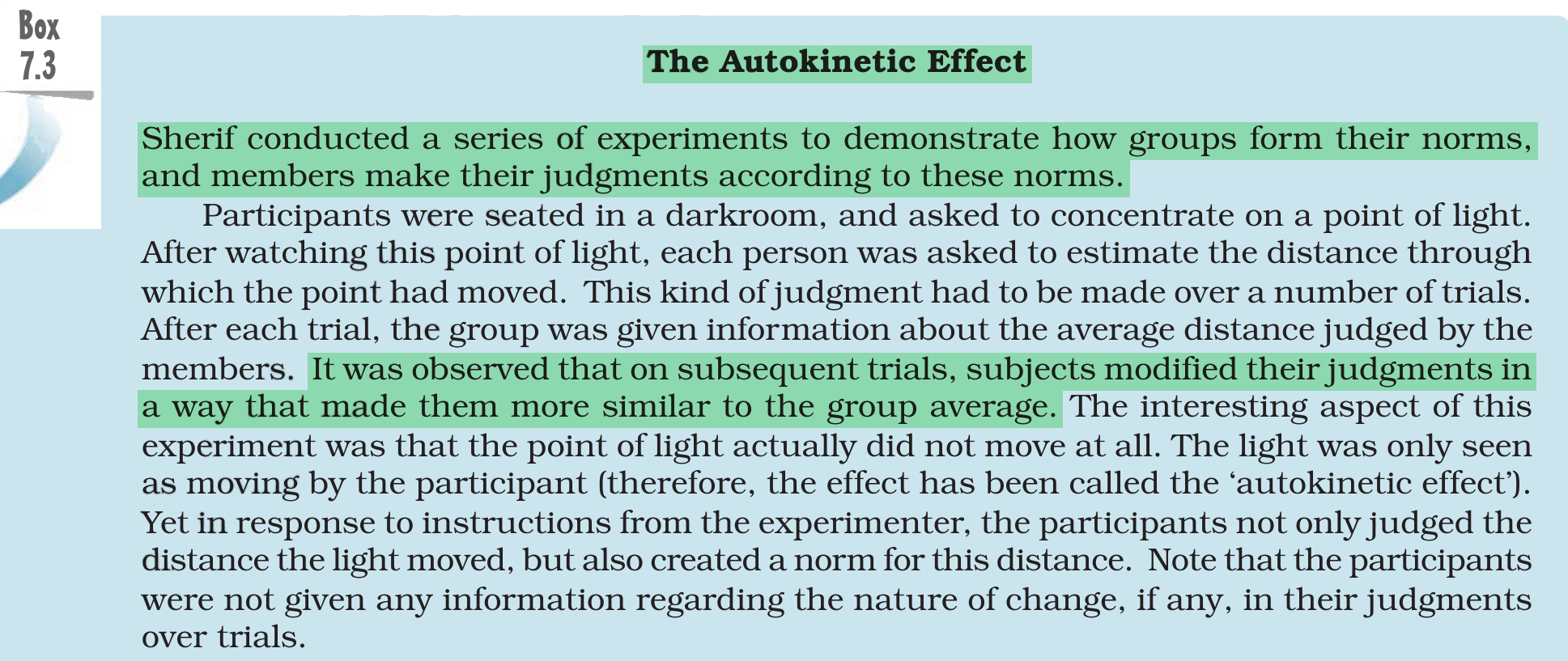
(A) The autokinetic effect — this matches (II) Conformity. In Sherif’s experiment in a dark room, a still point of light seemed to move, and over the trials each person’s estimate of the movement shifted towards the group average. It showed how groups form norms and how members go along with them.
(B) Milgram’s experiment — this matches (III) Obedience. Milgram showed that people obey commands even from strangers in authority: 65 per cent of the ‘teachers’ went on giving what they believed were painful shocks when the experimenter told them to.
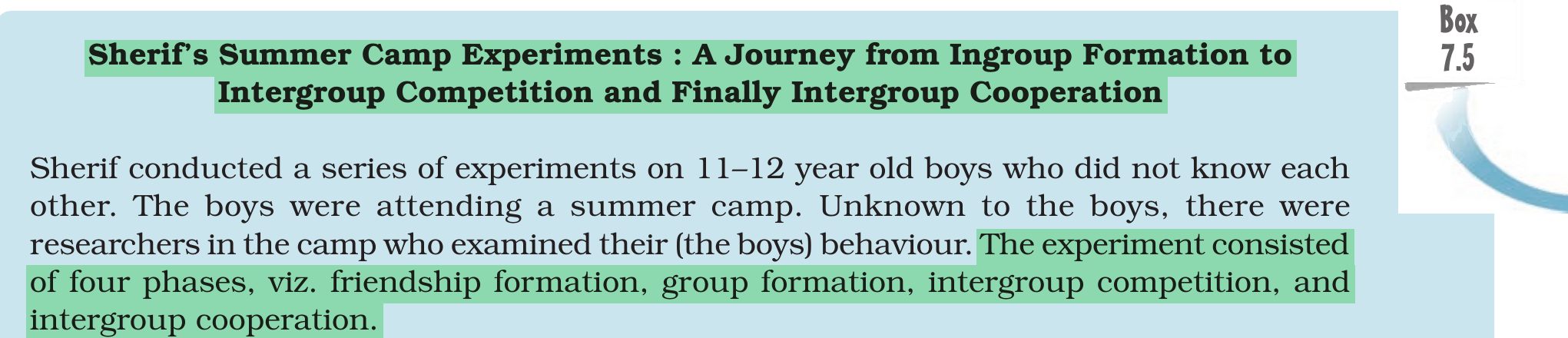
(C) Sherif’s experiment — this matches (I) Cooperation and competition conformity. Sherif’s summer camp experiments with 11–12 year old boys moved from friendship and ingroup formation to intergroup competition and finally intergroup cooperation.
(D) Latane — this matches (IV) Social loafing. Latane and his associates asked students to clap or cheer as loudly as possible, alone or in groups; the total noise rose with group size, but each person’s effort dropped, which is social loafing.
Note: The autokinetic effect, Milgram’s study of obedience and Sherif’s summer camp experiments, in the chapter ‘Social Influence and Group Processes’, were there in the pre-rationalised NCERT, which NTA followed in 2023, and are not there in the NCERT book (2025-26). Hence this question has been picked from the pre-rationalised NCERT.
NCERT (2025-26): “Social Loafing … Social loafing is a reduction in individual effort when working on a collective task, i.e. one in which outputs are pooled with those of other group members. An example of such a task is the game of tug-of-war. It is not possible for you to identify how much force each member of the team has been exerting. Such situations give opportunities to group members to relax and become a free rider. This phenomenon has been demonstrated in many experiments by Latane and his associates who asked group of male students to clap or cheer as loudly as possible as they (experimenters) were interested in knowing how much noise people make in social settings. They varied the group size; individuals were either alone, or in groups of two, four and six. The results of the study showed that although the total amount of noise rose up, as size increased, the amount of noise produced by each participant dropped.…” NCERT (Pre-rationalised): “The Autokinetic Effect … The pioneering experiments on conformity were carried out by Sherif and Asch. They illustrate some of the conditions that determine the extent of conformity, and also methods that may be adopted for the study of conformity in groups.…” “Obedience … When compliance is shown to an instruction or order from a person in authority, such as parents, teachers, leaders, or policemen, that behaviour is called obedience. Why people show obedience is easy to understand. Most often it is because if we disobey, some punishment might follow. Sometimes, it is because we believe that persons in authority must be obeyed. People in authority have effective means for enforcing their orders. Milgram conducted an experiment to show that individuals obey commands from people who are strangers.…”
Box 7.3: The Autokinetic Effect (Pre-rationalised)
Box 7.5: Sherif’s Summer Camp Experiments : A Journey from Ingroup Formation to Intergroup Competition and Finally Intergroup Cooperation (Pre-rationalised) |