Match the LIST-I with LIST-II
| LIST-I (Spectral series) | LIST-II (Region of EM spectrum) | ||
| A. | Lyman | I. | primarily near infrared |
| B. | Brackett | II. | Visible |
| C. | Balmer | III. | primarily middle infrared |
| D. | Paschen | IV. | Ultraviolet |
Choose the correct answer from the options given below:
Answer & explanation
Correct answer: option 3
The correct answer is Option (3) → A-IV, B-III, C-II, D-I
In the hydrogen spectrum each series ends on a fixed lower level \( n_f \). The higher the final level, the smaller the energy gaps, so the emitted lines move to longer wavelengths: \( n_f = 1 \) (Lyman), 2 (Balmer), 3 (Paschen), 4 (Brackett).
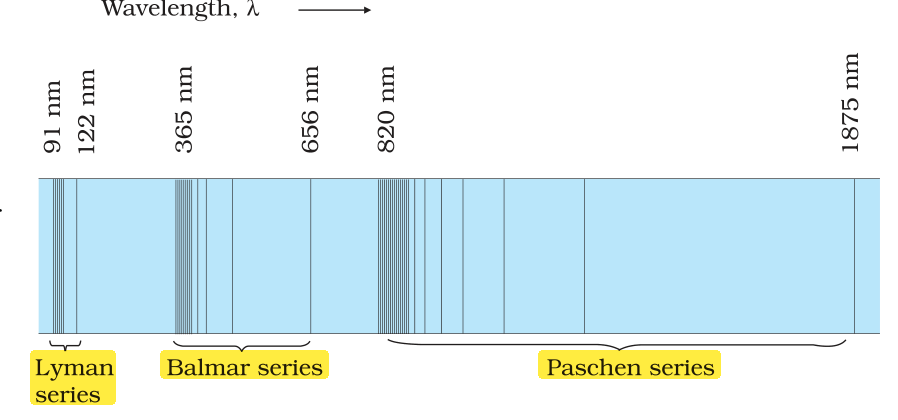
(A) Lyman — this matches (IV) Ultraviolet. Transitions to \( n = 1 \) release the largest energies, giving wavelengths of about 91 nm to 122 nm.
(B) Brackett — this matches (III) primarily middle infrared. Transitions to \( n = 4 \) give wavelengths of about 1.46 μm to 4.05 μm, the longest of the four series.
(C) Balmer — this matches (II) Visible. Transitions to \( n = 2 \) give lines from about 365 nm to 656 nm, the visible series (Hα is the red 656 nm line).
(D) Paschen — this matches (I) primarily near infrared. Transitions to \( n = 3 \) give wavelengths of about 0.82 μm to 1.87 μm, just beyond the red end of the visible.
Note: This question is from the pre-rationalised NCERT book (2022-23). The topic was removed from the latest NCERT book (2026-27), but it is still in the CUET 2026 syllabus, so do not skip it.
NCERT (Pre-rationalised edition, 2022-23):
Spectral Series – “… In 1885, the first such series was observed by a Swedish school teacher Johann Jakob Balmer (1825–1898) in the visible region of the hydrogen spectrum. This series is called Balmer series (Fig. 12.6).”
Spectral Series – “… The Lyman series is in the ultraviolet, and the Paschen and Brackett series are in the infrared region.”