The linear programming problem
max.\((z) = 5x + 7y\)
Subject to
\(x + y \ge 10\)
\(3x + 5y \le 15,\ x \ge 0,\ y \ge 0\):
Answer & explanation
Correct answer: option 2
The correct answer is Option (2) → is infeasible
Since \(x \ge 0\) and \(y \ge 0\), we have \(3x + 3y \le 3x + 5y\). With the constraint \(3x + 5y \le 15\):
\( 3(x + y) \le 3x + 5y \le 15 \)
\( x + y \le 5 \)
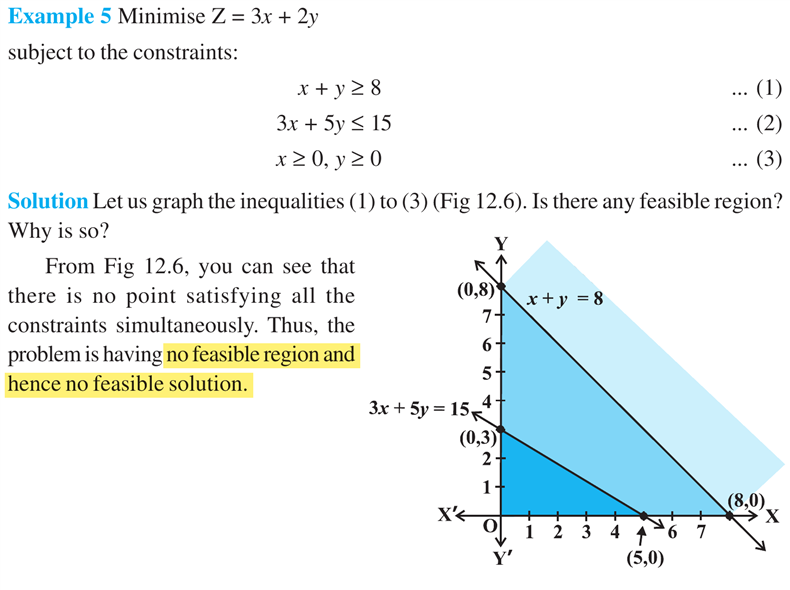
This contradicts \(x + y \ge 10\). No point satisfies all the constraints, so the feasible region is empty and the problem is infeasible.
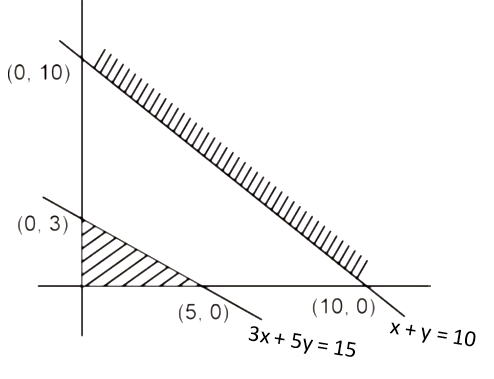
In the graph, the points with \(3x + 5y \le 15\) in the first quadrant lie on or below the line through (5, 0) and (0, 3), while \(x + y \ge 10\) needs points on or above the line through (10, 0) and (0, 10). The two regions have no common point.
NCERT (2026-27 edition):
Graphical Method of Solving Linear Programming Problems