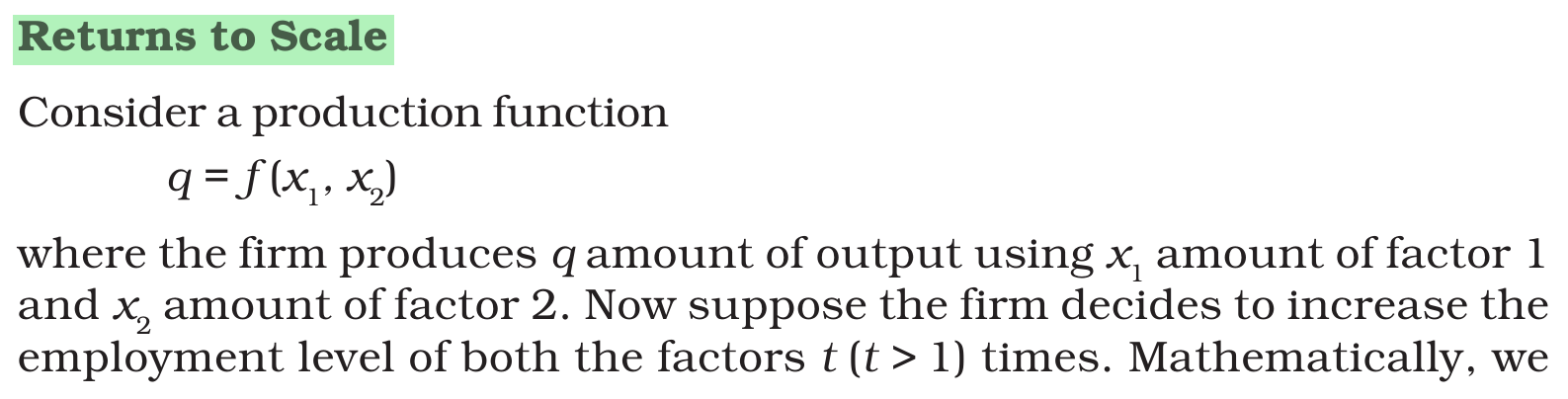
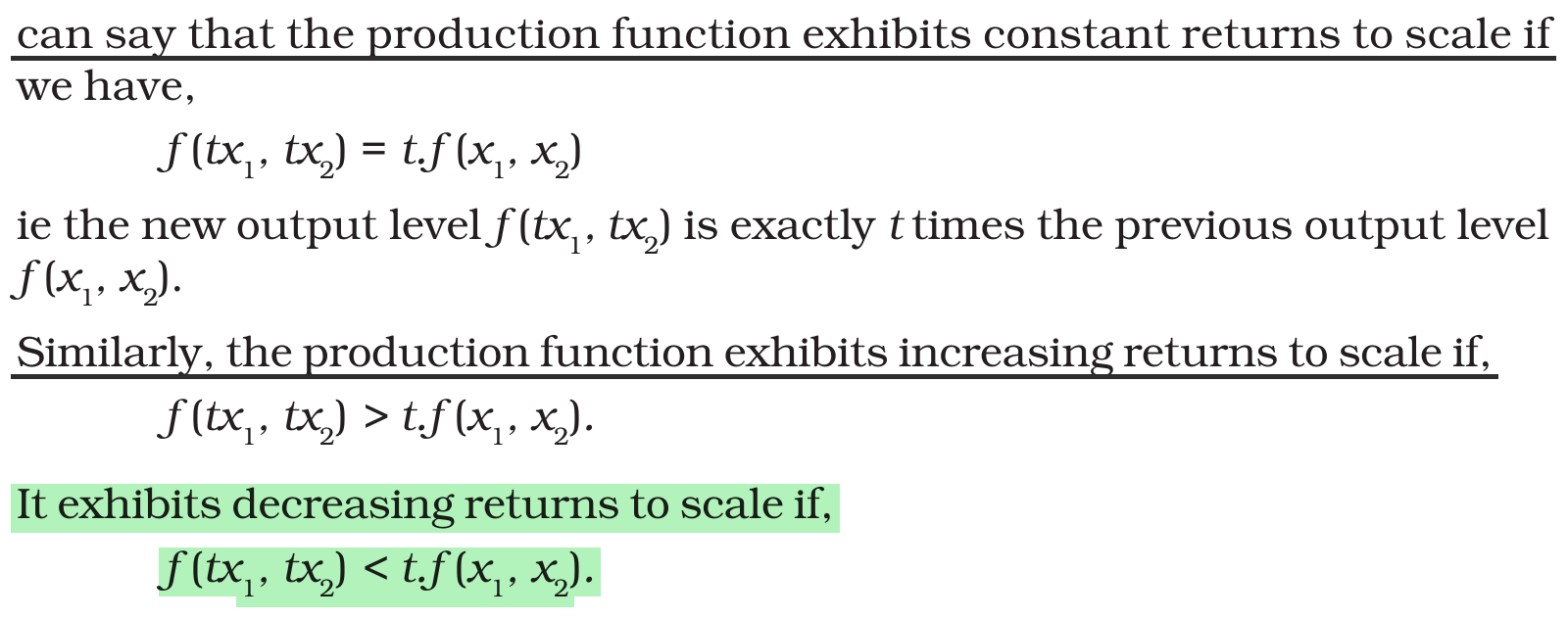
In given production function \( q = f (x_1, x_2) \) what is depicted by \( f(tx_1, tx_2) < t.f (x_1, x_2) \).
Answer & explanation
Correct answer: option 3
The correct answer is Option (3) → Decreasing returns to scale
The left side, \( f(tx_1, tx_2) \), is the output when both inputs rise t times, with t greater than 1. The right side is t times the old output. Since the left side is smaller, output rises less than t times. This is decreasing returns to scale.
Option (1) Constant returns to scale. — Incorrect. Output also rises t times: \( f(tx_1, tx_2) = t.f(x_1, x_2) \).
Option (2) Increasing returns to scale — Incorrect. Output rises more than t times: \( f(tx_1, tx_2) \gt t.f(x_1, x_2) \).
Option (3) Decreasing returns to scale — Correct. Output rises less than t times: \( f(tx_1, tx_2) \lt t.f(x_1, x_2) \).
Option (4) Marginal returns to scale. — Incorrect. There is no such term. ‘Marginal returns’ is another name for marginal product, the extra output from one more unit of one input.
NCERT (2026-27): Introductory Microeconomics — Chapter 3: Production and Costs
|