Read the passage below and answer the questions that follow:-
Just as individuals compare themselves with others in terms of similarities and differences with respect to what they have and what others have, individuals also compare the group they belong to with groups of which they are not a member. It has been found that groups are more likely to take extreme decisions than individuals alone. Suppose there is an employee who has been caught taking a bribe or engaging in some other unethical act. His/her colleagues are asked to decide what punishment he/she should be given. They may let him/her go scot-free or decide to terminate his/her services instead of imposing a punishment which may commensurate with the unethical act he/she had engaged in. Whatever the initial position in the group, this position becomes much stronger as a result of discussions and interaction in the group.
Match List-I with List-II
| List-I | List-II | ||
| (A) | Members are viewed differently and are often perceived negatively | (I) | Group polarisation |
| (B) | The strengthening of the group's initial position as a result of group interaction and discussion | (II) | Cohesiveness |
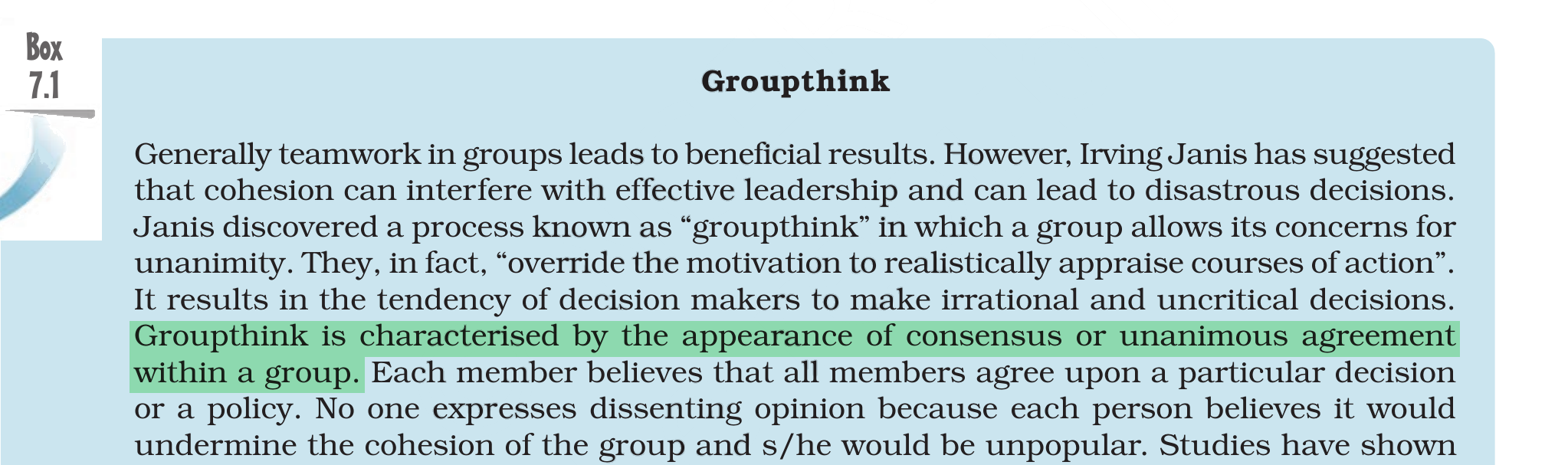
| (C) | Appearance of consensus or unanimous agreement within a group | (III) | Outgroup |
| (D) | Team spirit or 'we' feeling or a sense of belongingness to the group | (IV) | Groupthink |
Choose the correct answer from the options given below:
Answer & explanation
Correct answer: option 4
The correct answer is Option (4) → (A)-(III), (B)-(I), (C)-(IV), (D)-(II)
(A) Members are viewed differently and are often perceived negatively — this matches (III) Outgroup. The outgroup is another group, the ‘they’; compared with the ingroup, its members are viewed differently and often negatively.
(B) The strengthening of the group’s initial position as a result of group interaction and discussion — this matches (I) Group polarisation. Groups are more likely to take extreme decisions than individuals alone; whatever the group’s first position, discussion makes it much stronger.
(C) Appearance of consensus or unanimous agreement within a group — this matches (IV) Groupthink. Irving Janis found that in groupthink a group’s concern for unanimity overrides the motivation to realistically appraise courses of action. No one voices dissent for fear of breaking the group’s cohesion, so all members seem to agree.
(D) Team spirit or ‘we’ feeling or a sense of belongingness to the group — this matches (II) Cohesiveness. Cohesiveness is the togetherness, binding or mutual attraction among group members; members of a cohesive group think, feel and act as a social unit.
NCERT (2025-26): “Ingroup and Outgroup … It has been found that persons in the ingroup are generally supposed to be similar, are viewed favourably, and have desirable traits. Members of the outgroup are viewed differently and are often perceived negatively in comparison to the ingroup members.…” “Nature and Formation of Groups … Cohesiveness refers to togetherness, binding, or mutual attraction among group members. As the group becomes more cohesive, group members start to think, feel and act as a social unit, and less like isolated individuals. Members of a highly cohesive group have a greater desire to remain in the group in comparison to those who belong to low cohesive groups. Cohesiveness refers to the team spirit or ‘we feeling’ or a sense of belongingness to the group.…” “Group Polarisation … Groups show another tendency referred to as ‘group polarisation’. It has been found that groups are more likely to take extreme decisions than individuals alone. Suppose there is an employee who has been caught taking bribe or engaging in some other unethical act. Her/his colleagues are asked to decide on what punishment s/ he should be given. They may let her/ him go scot-free or decide to terminate her/his services instead of imposing a punishment which may be commensurate with the unethical act s/ he had engaged in. Whatever the initial position in the group, this position becomes much stronger as a result of discussions in the group. This strengthening of the group’s initial position as a result of group interaction and discussion is referred to as group polarisation.…”
|