
CUETMOCK
  • Pricing
  • Mentors
Log inStart freeStart free mocks→

First test, then trust

Try a free CUET mock test.

Join 5,00,000+ students who rehearsed exam day on the exact NTA screen before sitting CUET. On the web and on Android.

Start free mocks →Get the Android app
CUETMOCK

India's #1 CUET Mock Test Platform. Original NCERT-based questions on the exact NTA exam screen — trusted by 5,00,000+ students since CUET 2022.

Get it onGoogle PlayScan to download the CUETMOCK app

Mock tests

  • CUET mock test series
  • Commerce mocks
  • Humanities (Arts) mocks
  • Science mocks
  • Languages & GAT mocks
  • Free practice questions
  • Pricing

Resources

  • CUET exam guide
  • CUET syllabus
  • Universities accepting CUET
  • Expert blogs
  • News & notifications
  • Webinars & counselling
  • CUET score calculator
  • How we estimate your rank
  • FAQs

Company

  • About us
  • Our leadership & team
  • Our toppers
  • Mentors
  • For schools
  • Contact us
  • Terms
  • Privacy
  • Refund policy

Talk to us

+91 7696 6630 56info@cuetmock.comWhatsApp us

Our other platforms

  • JEE Mock — For IIT-JEE aspirants
  • NEET Mock — For NEET aspirants

Newsletter

Exam updates, study material and offers — no spam.

© 2026 NYC Ventures Pvt. Ltd.

701-702, Royal Business Park, Zirakpur, Punjab - 140603

  • Terms of use
  • Privacy policy
  • Refund policy
  • Contact us

iCUETMOCK is an independent preparation platform, not affiliated with the National Testing Agency (NTA). Always check exam details on the official NTA website.

  • Home
  • Mock tests
  • CUET guide
  • Pricing
  • Log in
Home/Practice questions/Chemistry
ChemistryOrganic: Amines

In the following series of chemical reactions, identify the final pro…

In the following series of chemical reactions, identify the final product D.
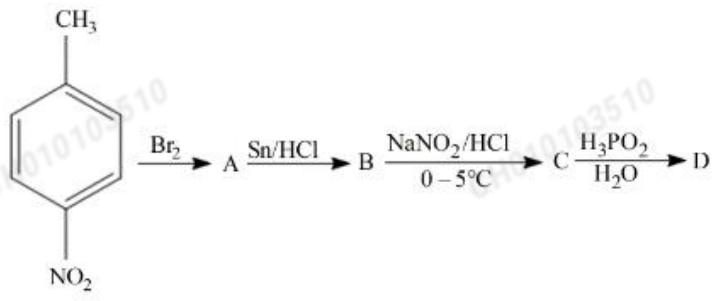
Figure for Q20

Answer & explanation+

Correct answer: option 4

The correct answer is Option (4) → 2-bromotoluene

This sequence uses a nitrogen group as a temporary director. The group steers the bromine into place and is then removed completely, by reducing it to –\( \ce{NH2} \), diazotising it, and replacing the diazonium group with hydrogen using \( \ce{H3PO2} \).

Bromination (A): In 4-nitrotoluene, –\( \ce{CH3} \) is an activating ortho/para director, and its para position is already taken. –\( \ce{NO2} \) is a meta director. Both groups point to the same carbon, ortho to –\( \ce{CH3} \) and meta to –\( \ce{NO2} \). So A is 2-bromo-4-nitrotoluene:

    \( \displaystyle \ce{CH3C6H4NO2 + Br2 -> CH3C6H3(Br)NO2 + HBr} \)

Reduction (B): Sn/HCl reduces –\( \ce{NO2} \) to –\( \ce{NH2} \), giving 3-bromo-4-methylaniline:

    \( \displaystyle \ce{CH3C6H3(Br)NO2 + 6[H]} \xrightarrow{\ce{Sn/HCl}} \ce{CH3C6H3(Br)NH2 + 2H2O} \)

Diazotisation (C): \( \ce{NaNO2} \)/HCl at 273–278 K converts –\( \ce{NH2} \) into the diazonium group, –\( \ce{N2^{+}Cl^{-}} \). Writing Ar for the 3-bromo-4-methylphenyl group:

    \( \displaystyle \ce{ArNH2 + NaNO2 + 2HCl} \xrightarrow{\text{273-278 K}} \ce{ArN2^{+}Cl^{-} + NaCl + 2H2O} \)

Deamination (D): Hypophosphorous acid replaces the diazonium group by hydrogen:

    \( \displaystyle \ce{ArN2^{+}Cl^{-} + H3PO2 + H2O -> ArH + N2 ^ + H3PO3 + HCl} \)

The nitrogen group has now gone, leaving –\( \ce{CH3} \) and –Br on neighbouring carbons. So D is 2-bromotoluene.

Why the other options are incorrect

  • Option (1) toluene — Incorrect. Only the diazonium group is replaced by hydrogen; the bromine atom stays on the ring.

  • Option (2) 3-bromotoluene — Incorrect. The position meta to –\( \ce{CH3} \) is ortho to –\( \ce{NO2} \), and neither group directs bromine there.

  • Option (3) 4-bromotoluene — Incorrect. The para position was held by the nitrogen group, which is replaced by hydrogen, not by bromine. Replacing it by Br would need CuBr/HBr (Sandmeyer reaction).

NCERT (2026-27 edition):
Replacement by H

Textbook extract

Advertisement

Practise more on Organic: Amines

Chapter-wise mocks on the real NTA exam screen, with solutions and your rank. Your first mocks are free.

Start free mocks →

Advertisement

Next questions

  1. Match List-I with List-II.List-IList-II(A) Moneylenders and traders(I) Fill the gap in the formal credit system(B) Commercial banks, RRBs,…Economics · Indian Economic Development: Rural Development
  2. A cube of side 15 cm is cut into small cubes of side 3 cm each. How many such small cubes can be obtained?General Aptitude Test · Quantitative Reasoning
  3. The capital account items of a country’s balance of payments are given below:Item (net)Million USDExternal assistance5External commercial b…Economics · Macro Economics: Open Economy Macro Economics
  4. Calculate the standard Gibbs energy.The standard electrode potential for given cell is 1.7 V. (F = 96487 C mol−1)Cu (s) + 2Ag+ (aq) → Cu2+…Chemistry · Physical: Electro Chemistry
  5. निम्नलिखित में से 'अनुज' का विलोम है-Hindi · Antonyms
  6. Sucrose is boiled with dilute hydrochloric acid, and the product mixture is called invert sugar. Which of the following explains this name?Chemistry · Organic: Biomolecules
  7. Select the grammatically correct sentence from the options given below:English · Grammar: Verb
  8. Identify the correct statement regarding the ‘Subsidiary Alliance’ system:History · Modern India: Rebels and the Raj
  9. The ratio of the income of A to that of B is 2 : 5. A and B save Rs 3,000 and Rs 6,000 respectively. If the expenditure of A is equal to 25…General Aptitude Test · Numerical Ability
  10. 'उन्होंने किताब खरीदी होगी' में कौन-सा भूतकाल है?Hindi · काल