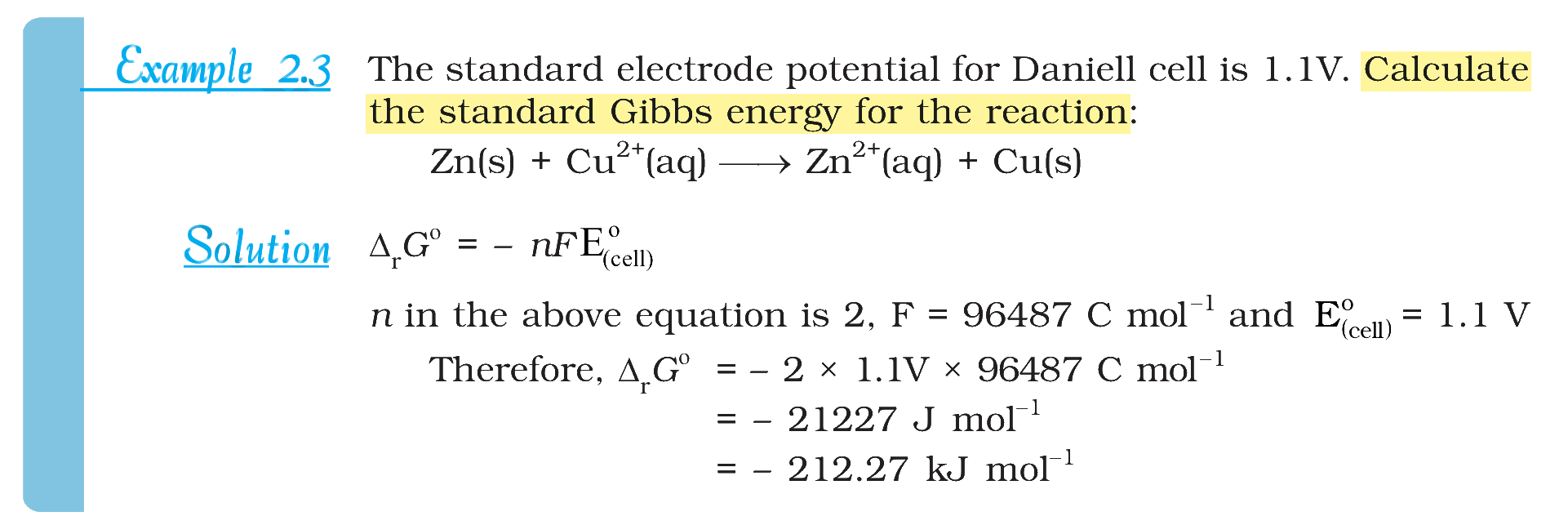
Calculate the standard Gibbs energy.
The standard electrode potential for given cell is 1.7 V. (F = 96487 C mol−1)
Cu (s) + 2Ag+ (aq) → Cu2+ (aq) + 2Ag (s)
Answer & explanation
Correct answer: option 1
The correct answer is Option (1) → −3.28 × 10⁵ J mol−1
The electrical work done by a galvanic cell comes from the decrease in Gibbs energy of the cell reaction. Under standard conditions:
\( \displaystyle \Delta_rG^\circ=-nFE^\circ_{\mathrm{cell}} \)
where n is the number of electrons transferred in the balanced reaction and F is the Faraday constant. A positive E°cell gives a negative ΔrG°, i.e. a spontaneous reaction.
Finding n from the two half reactions:
\( \displaystyle \ce{Cu -> Cu^2+ + 2e^-} \)
\( \displaystyle \ce{2Ag^+ + 2e^- -> 2Ag} \)
So n = 2. Substituting the given values:
\( \displaystyle \Delta_rG^\circ=-2\times96487\times1.7 \)
\( \displaystyle \Delta_rG^\circ=-328055.8\ \mathrm{J\,mol^{-1}}\approx-3.28\times10^{5}\ \mathrm{J\,mol^{-1}} \)
Shortcut: A positive cell potential must give a negative ΔG°, which leaves Options (1) and (4). Since 2 × 96487 × 1.7 is roughly 3.3 × 10⁵, the answer is Option (1).
Note 1: NTA picked this question from an NCERT (2026-27) example and changed the figures. Do not ignore NCERT while practising numericals.
Note 2: It seems that there is a mistake in the original NTA paper, which prints 1.7 V for this cell, whereas E°cell = 0.80 − 0.34 = 0.46 V.
NCERT (2026-27 edition):
Electrochemical Cell and Gibbs Energy of the Reaction – …