CUETMOCK
  • Pricing
  • Mentors
Log inStart freeStart free mocks→

First test, then trust

Try a free CUET mock test.

Join 5,00,000+ students who rehearsed exam day on the exact NTA screen before sitting CUET. On the web and on Android.

Start free mocks →Get the Android app
CUETMOCK

India's #1 CUET Mock Test Platform. Original NCERT-based questions on the exact NTA exam screen — trusted by 5,00,000+ students since CUET 2022.

Get it onGoogle PlayScan to download the CUETMOCK app

Mock tests

  • CUET mock test series
  • Browse all papers
  • Commerce mocks
  • Humanities (Arts) mocks
  • Science mocks
  • Languages & GAT mocks
  • Free practice questions
  • Pricing

Resources

  • CUET exam guide
  • CUET syllabus
  • Universities accepting CUET
  • Expert blogs
  • News & notifications
  • Webinars & counselling
  • CUET score calculator
  • How we estimate your rank
  • FAQs

Company

  • About us
  • Our leadership & team
  • Our toppers
  • Mentors
  • For schools
  • Contact us
  • Terms
  • Privacy
  • Refund policy

Talk to us

+91 7696 6630 56info@cuetmock.comWhatsApp us

Our other platforms

  • JEE Mock — For IIT-JEE aspirants
  • NEET Mock — For NEET aspirants

Newsletter

Exam updates, study material and offers — no spam.

© 2026 NYC Ventures Pvt. Ltd.

701-702, Royal Business Park, Zirakpur, Punjab - 140603

  • Terms of use
  • Privacy policy
  • Refund policy
  • Contact us

iCUETMOCK is an independent preparation platform, not affiliated with the National Testing Agency (NTA). Always check exam details on the official NTA website.

  • Home
  • Mock tests
  • CUET guide
  • Pricing
  • Log in
Home/Practice questions/General Aptitude Test
General Aptitude TestVerbal ReasoningSyllogism

Two statements are given followed by Three conclusions numbered I, II…

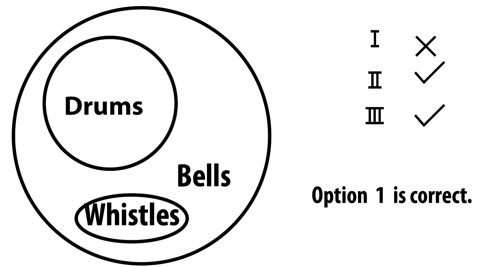
Two statements are given followed by Three conclusions numbered I, II and III. Assuming the statements to be true, even if they seem to be at variance with commonly known facts, decide which of the conclusions logically follow(s) from the statements.

Statements:

All drums are bells.

All whistles are bells.

Conclusions:

I. Some drums are whistles.

II. Some bells are drums.

III. Some bells are whistles.

Answer & explanation+

Correct answer: option 1

Advertisement

Practise more on Verbal Reasoning

Chapter-wise mocks on the real NTA exam screen, with solutions and your rank. Your first mocks are free.

Start free mocks →

Advertisement

Next questions

  1. People spend money to find out the salaries of different jobs, and whether colleges teach useful job skills and at what fee. Why is such sp…Economics · Indian Economic Development: Human Capital Formation in India
  2. What was the 'Kalyana mandapa' used for?History · Medieval India: An Imperial Capital: Vijayanagara
  3. Halpati system in Gujarat and the jeeta system in Karnataka are______Sociology · Social Change and Development in India: Change and Development in Rural Society
  4. Select the appropriate synonym for the underlined word. In the absence of miracles, my frustration spikes.English · Synonyms
  5. What was the primary responsibility of the second subcommittee in Megasthenes' military committee?History · Ancient India: Kings, Farmers and Towns
  6. In order to Correct a #DIV/0! Error, the following steps are used. Arrange them in proper order.(A) Enter a value other than zero in the ce…Accountancy Part C · Spreadsheet
  7. The following are the benefits of doing a part time job: Pick out the wrong statement:-English · Comprehension - (Narrative / Factual)
  8. If (x + 3, 4 – y) = (1, 7), then (x – 3, 4 + y) is equal toMaths. Section B1 · Relations and Functions
  9. Which one of the following is an educational town?Geography · India-People and Economy: Human Settlements
  10. The uplifted blocks of block mountains are called ______.General Aptitude Test · General Knowledge