Which sodium halide is employed in Finkelstein reaction?
Answer & explanation
Correct answer: option 4
The correct answer is Option (4) → Sodium iodide
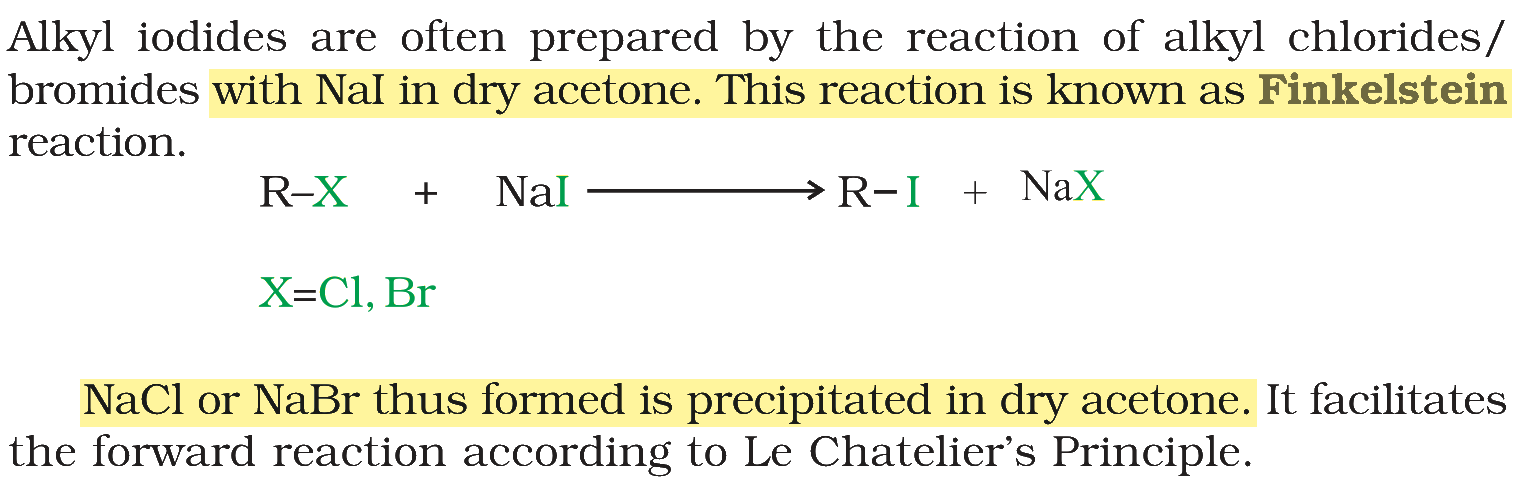
Halogen exchange reactions make one alkyl halide from another. In the Finkelstein reaction an alkyl chloride or bromide is heated with sodium iodide in dry acetone and the alkyl iodide is formed:
\( \displaystyle \ce{R-X + NaI} \xrightarrow{\text{dry acetone}} \ce{R-I + NaX v} \qquad (\ce{X} = \ce{Cl}, \ce{Br}) \)
The precipitation of NaCl or NaBr in dry acetone drives the reaction forward. So the sodium halide used is sodium iodide. The related Swarts reaction makes alkyl fluorides by heating an alkyl chloride or bromide with a metallic fluoride such as AgF, \( \ce{Hg2F2} \), \( \ce{CoF2} \) or \( \ce{SbF3} \):
\( \displaystyle \ce{CH3Br + AgF -> CH3F + AgBr} \)
NCERT (2026-27 edition):
Halogen Exchange