Arrange the following statements in correct sequence with respect to government budget's objective.
A. When demand exceeds for available output under the condition of full employment.
B. May give rise to inflation in the economy.
C. The intervention of the government to stabilize the economy.
D. The overall level of employment and prices depend upon the level of aggregate demand.
Choose the correct answer from the options given below:
Answer & explanation
Correct answer: option 4
The correct answer is Option (4) → D, A, B, C
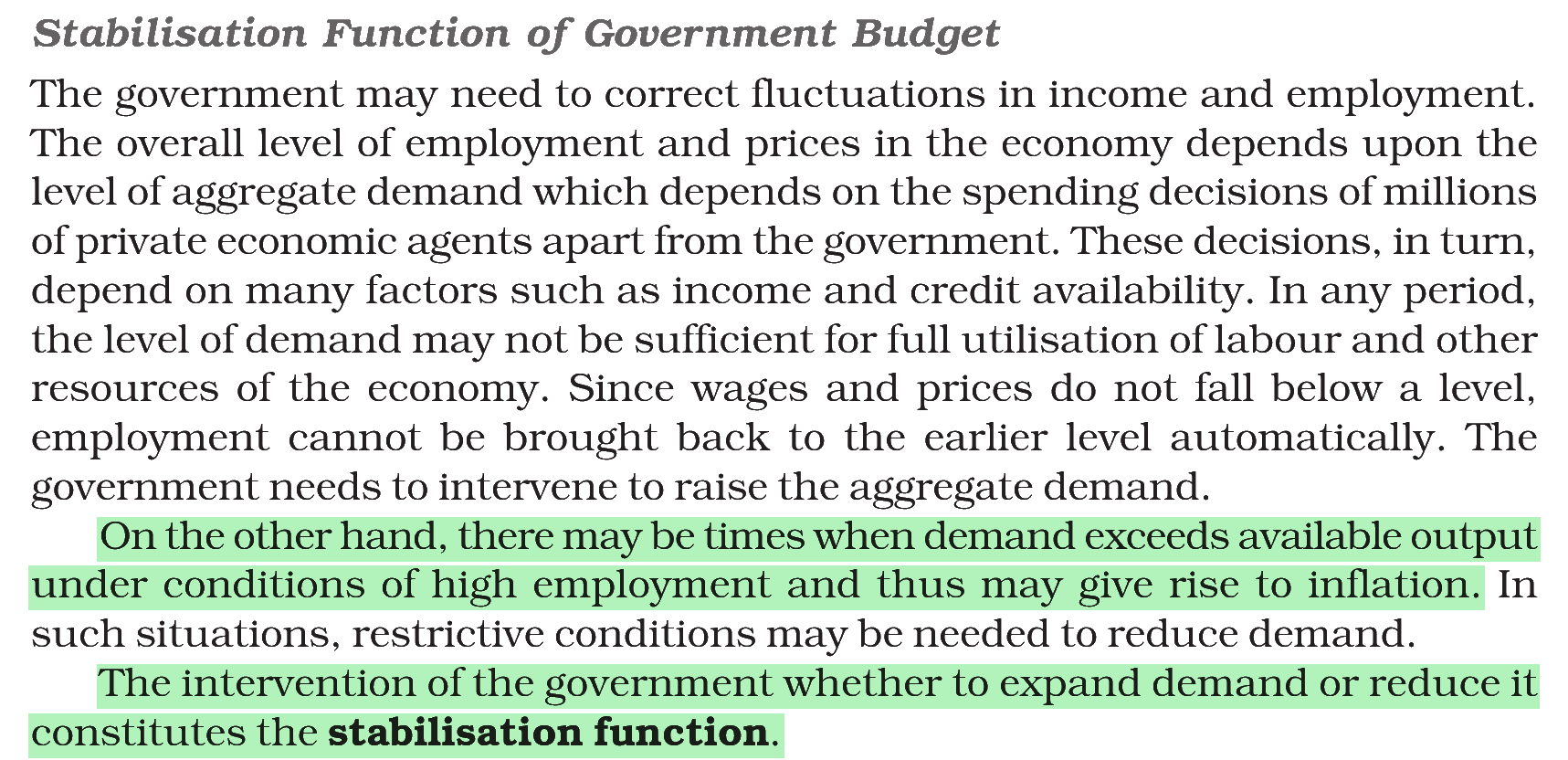
How many people find work and what happens to prices both depend on aggregate demand, the total planned spending of households, firms and the government on the economy’s output. Firms produce what they expect to sell, so output and jobs follow demand, up to the limit of full employment, where all the resources willing to work are already in use. Two cases can then arise:
Demand falls short of what the economy can produce at full employment: goods remain unsold, firms cut output and unemployment appears.
Demand exceeds the output available at full employment: output cannot rise any further, so the extra spending only pushes up prices, and there is inflation.
In either case the government can step in through its budget, raising its spending or cutting taxes when demand is too low and doing the opposite when it is too high. This is the stabilisation function of the budget. The four statements follow this chain from cause to remedy:
(D) The overall level of employment and prices depend upon the level of aggregate demand. The starting point: the relationship on which the rest depends.
(A) When demand exceeds for available output under the condition of full employment. The problem case: excess demand when output is already at its full-employment limit.
(B) May give rise to inflation in the economy. Its result: rising prices.
(C) The intervention of the government to stabilize the economy. The remedy: the government uses its taxes and expenditure to bring demand back in line with output.
NCERT: Introductory Macroeconomics — Chapter 5: Government Budget and the Economy (2025-26)
|