
CUETMOCK
  • Pricing
  • Mentors
Log inStart freeStart free mocks→

First test, then trust

Try a free CUET mock test.

Join 5,00,000+ students who rehearsed exam day on the exact NTA screen before sitting CUET. On the web and on Android.

Start free mocks →Get the Android app
CUETMOCK

India's #1 CUET Mock Test Platform. Original NCERT-based questions on the exact NTA exam screen — trusted by 5,00,000+ students since CUET 2022.

Get it onGoogle PlayScan to download the CUETMOCK app

Mock tests

  • CUET mock test series
  • Commerce mocks
  • Humanities (Arts) mocks
  • Science mocks
  • Languages & GAT mocks
  • Free practice questions
  • Pricing

Resources

  • CUET exam guide
  • CUET syllabus
  • Universities accepting CUET
  • Expert blogs
  • News & notifications
  • Webinars & counselling
  • CUET score calculator
  • How we estimate your rank
  • FAQs

Company

  • About us
  • Our leadership & team
  • Our toppers
  • Mentors
  • For schools
  • Contact us
  • Terms
  • Privacy
  • Refund policy

Talk to us

+91 7696 6630 56info@cuetmock.comWhatsApp us

Our other platforms

  • JEE Mock — For IIT-JEE aspirants
  • NEET Mock — For NEET aspirants

Newsletter

Exam updates, study material and offers — no spam.

© 2026 NYC Ventures Pvt. Ltd.

701-702, Royal Business Park, Zirakpur, Punjab - 140603

  • Terms of use
  • Privacy policy
  • Refund policy
  • Contact us

iCUETMOCK is an independent preparation platform, not affiliated with the National Testing Agency (NTA). Always check exam details on the official NTA website.

  • Home
  • Mock tests
  • CUET guide
  • Pricing
  • Log in
Home/Practice questions/Chemistry
ChemistryOrganic: Aldehydes, Ketones and Carboxylic Acids

In the following reaction, identify A and B.
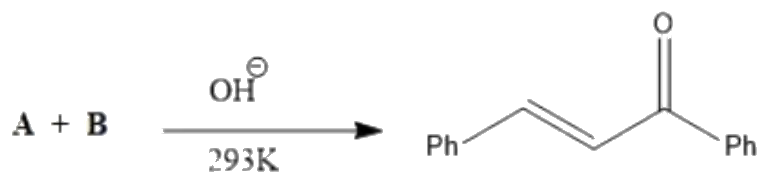
In the following reaction, identify A and B.

Figure for Q27

Answer & explanation+

Correct answer: option 1

The correct answer is Option (1) → A = Benzaldehyde, B = Acetophenone

An aldehyde or ketone with an α-hydrogen forms a carbanion (enolate) in dilute alkali. This carbanion adds to the C=O group of another carbonyl compound (aldol addition), and the product then loses water to give an α,β-unsaturated carbonyl compound (aldol condensation). When the two partners are different, it is a cross aldol condensation; with an aromatic aldehyde and a ketone it is called the Claisen–Schmidt reaction.

The product Ph–CH=CH–CO–Ph can be split at the C=C bond into its two parts:

  • Ph–CH= comes from benzaldehyde, \( \ce{C6H5CHO} \), which has no α-hydrogen and can only accept the carbanion.

  • =CH–CO–Ph comes from acetophenone, \( \ce{C6H5COCH3} \), whose \( \ce{CH3} \) group supplies the α-hydrogens and forms the carbanion.

    \( \displaystyle \ce{C6H5CHO + CH3COC6H5} \xrightarrow[\text{293 K}]{\ce{OH^-}} \ce{C6H5CH=CHCOC6H5 + H2O} \)

The product is benzalacetophenone (chalcone).

Why the other options are incorrect

  • Option (2) A = Benzaldehyde, B = Acetone — Incorrect. Acetone would give \( \ce{Ph-CH=CH-CO-CH3} \) (benzalacetone), which has a methyl group, not a phenyl group, on the C=O.

  • Option (3) A = Benzaldehyde, B = Benzophenone — Incorrect. Benzophenone (Ph–CO–Ph) has no α-hydrogen, so it cannot form the carbanion; with benzaldehyde no aldol condensation is possible.

  • Option (4) A = Acetophenone, B = Acetophenone — Incorrect. Self-condensation of acetophenone gives \( \ce{Ph-C(CH3)=CH-CO-Ph} \), which carries an extra methyl group on the double bond.

NCERT (2026-27 edition):
Cross Aldol Condensation
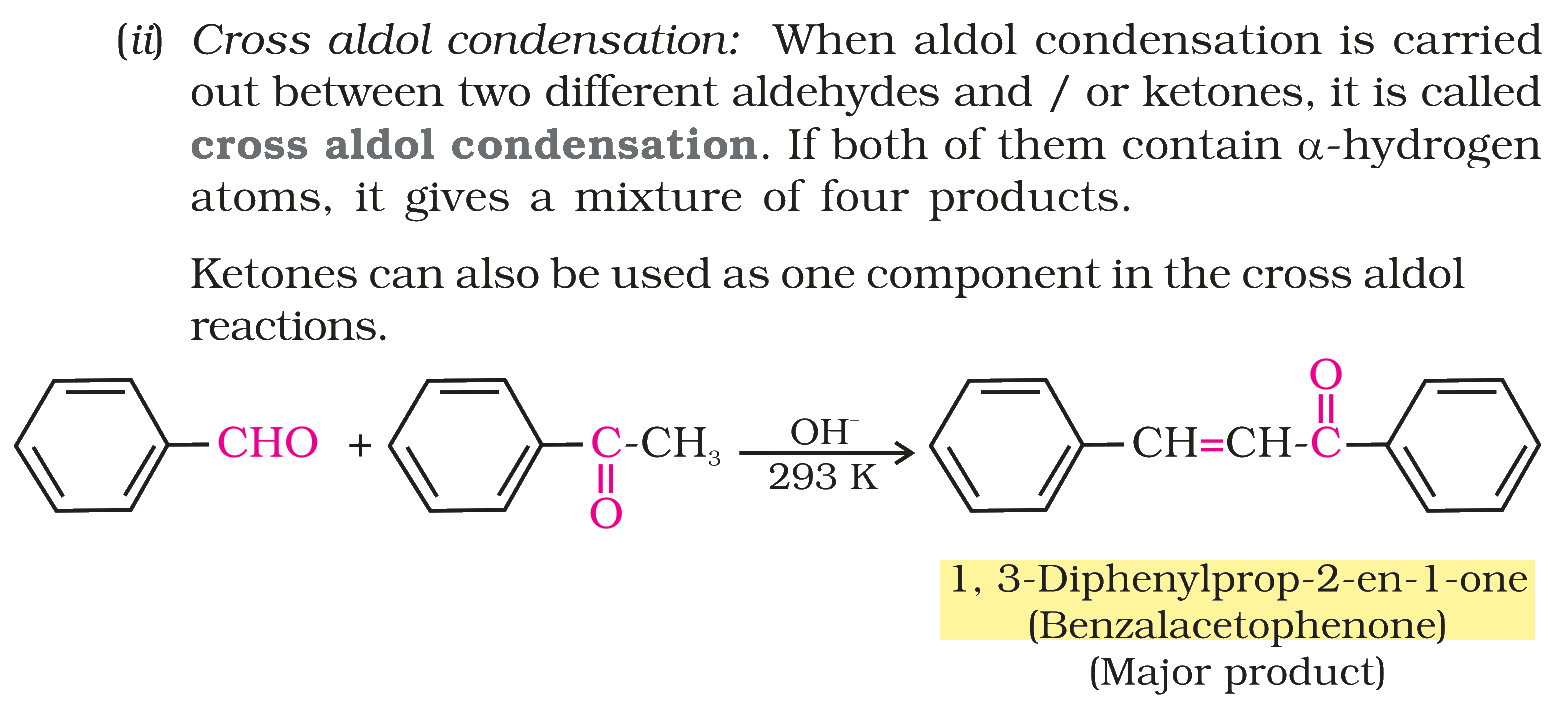
Textbook extract

Advertisement

Practise more on Organic: Aldehydes, Ketones and Carboxylic Acids

Chapter-wise mocks on the real NTA exam screen, with solutions and your rank. Your first mocks are free.

Start free mocks →

Advertisement

Next questions

  1. Arrange the following in chronological order (Oldest to latest).(A) Establishment of WTO(B) Introduction of New Economic Reforms(C) Establi…Economics · Indian Economic Development: Liberalisation, Privatisation and Globalisation - An Appraisal
  2. Identify the correct statement with reference to the ‘mansabdari-system’ of Mughal administration:History · Medieval India: Peasants, Zamindars and the State
  3. Identify the Figure of Speech used in the given sentence :-She was impressed to see shining silver spoons at the serving counter.English · Figure of Speech
  4. Match List-I with List-II (Symbols have their usual meaning)List-IList-II(A) Magnetic field due to an infinitely long straight conductor(I)…Physics · Moving Charges and Magnetism
  5. Which amino acid is optically inactive?Chemistry · Organic: Biomolecules
  6. “Principle of division of work is applicable to a government office where there is a diary/dispatch clerk whose job is to receive and send…Business Studies · Principles of Management
  7. Which among the following statements are correct about India’s stance on environmental issues?(A) India participates in global efforts to t…Political Science · Contemporary World Politics: Environment and Natural Resources
  8. When a Partner dies in the Middle of the Year, which accounting adjustment / calculation is not done for the intervening period?Accountancy Part A · Reconstitution of Partnership Firm: Retirement and Death
  9. Choose the option that correctly transforms this sentence from direct speech to indirect speech:-The economist said, “Social media platform…English · Direct/indirect
  10. Biochemical oxygen demand refers to -Biology · Microbes in Human Welfare