
Which of the given complexes will be optically active?
cis-[PtCl2(en)2]2+, trans-[PtCl2(en)2]2+, cis-[CrCl2(ox)2]3−, trans-[CrCl2(ox)2]3−
Answer & explanation
Correct answer: option 1
The correct answer is Option (1) → cis-[PtCl2(en)2]2+ and cis-[CrCl2(ox)2]3−
A complex is optically active when its mirror image cannot be superimposed on it, that is, when it has no plane of symmetry. In an octahedral complex of the type [M(AA)2X2], the trans form has a plane of symmetry and is optically inactive, while the cis form has none and exists as a pair of enantiomers.
Both ethane-1,2-diamine (en) and oxalate (ox) are bidentate ligands, so both complexes are of the [M(AA)2X2] type. Hence cis-[PtCl2(en)2]2+ and cis-[CrCl2(ox)2]3− are optically active.
Shortcut: A trans [M(AA)2X2] complex always has a plane of symmetry. Only Option (1) contains no trans isomer.
NCERT (2026-27 edition):
Optical Isomerism – “… Optical isomerism is common in octahedral complexes involving didentate ligands (Fig. 5.6). In a coordination entity of the type [PtCl2(en)2]2+, only the cis-isomer shows optical activity (Fig. 5.7).”
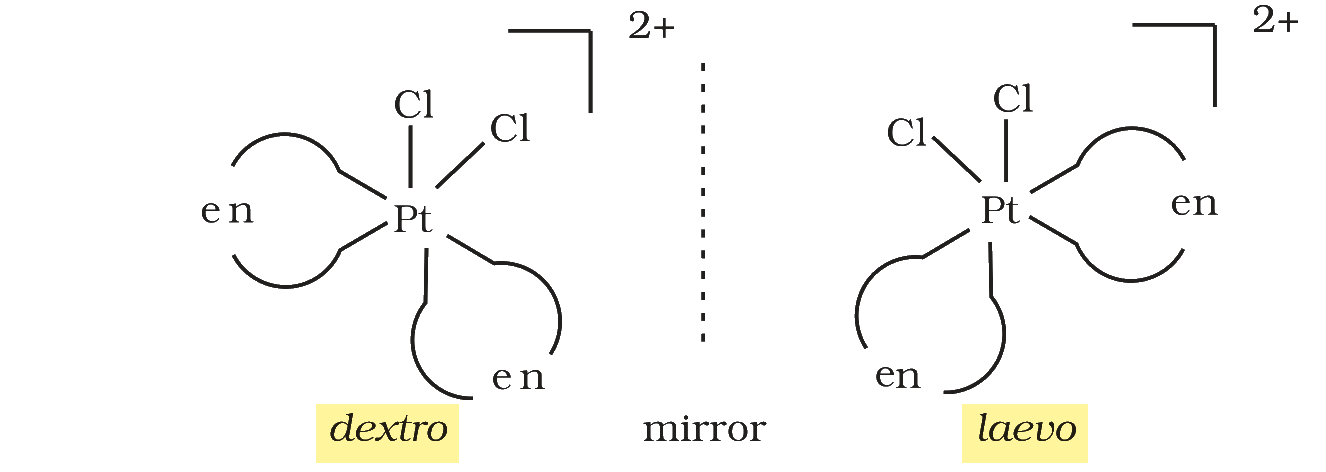
Example 5.6 – “Out of the following two coordination entities which is chiral (optically active)? (a) cis-[CrCl2(ox)2]3– (b) trans-[CrCl2(ox)2]3– … Out of the two, (a) cis-[CrCl2(ox)2]3– is chiral (optically active).”