Electric power was generated in the Apollo space programme through
Answer & explanation
Correct answer: option 1
The correct answer is Option (1) → Fuel cells
Galvanic cells that are used as practical sources of electricity fall into three groups:
Primary cells cannot be recharged, for example the dry cell and the mercury cell (used in hearing aids and watches).
Secondary cells can be recharged, for example the lead storage battery (used in automobiles and inverters) and the nickel-cadmium cell (longer life than the lead battery).
Fuel cells convert the energy of burning fuels such as hydrogen directly into electrical energy, with the reactants supplied continuously.
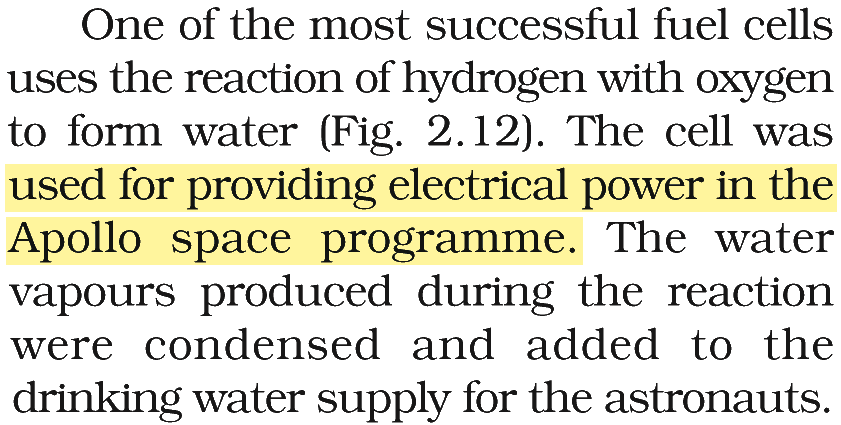
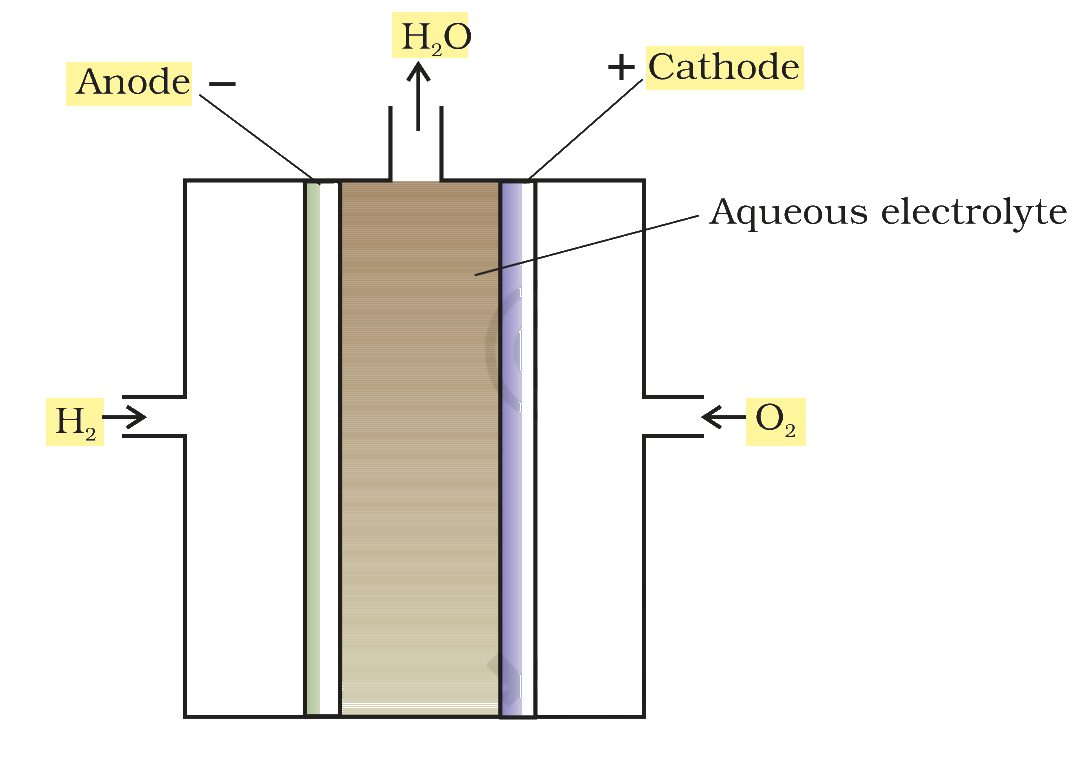
The H2–O2 fuel cell was used to generate electric power in the Apollo space programme. Hydrogen and oxygen are bubbled through porous carbon electrodes into concentrated aqueous NaOH:
\( \displaystyle \text{Cathode: }\ce{O2 + 2H2O + 4e^- -> 4OH^-} \)
\( \displaystyle \text{Anode: }\ce{2H2 + 4OH^- -> 4H2O + 4e^-} \)
\( \displaystyle \text{Cell reaction: }\ce{2H2 + O2 -> 2H2O} \)
So the power in the Apollo programme came from fuel cells.
NCERT (2026-27 edition):
Fuel Cells – …