A primary alkyl halide would prefer to undergo ___________
Answer & explanation
Correct answer: option 2
The correct answer is Option (2) → SN2 reaction
Alkyl halides undergo nucleophilic substitution by two mechanisms:
SN2 (bimolecular): a single step. The nucleophile attacks the carbon from the side opposite to the halogen while the C–X bond breaks. The attack is hindered by bulky groups, so reactivity is CH3X > 1° > 2° > 3°. The configuration is inverted.
SN1 (unimolecular): two steps. The C–X bond first breaks to give a carbocation, which the nucleophile then attacks. The more stable the carbocation, the faster the reaction, so reactivity is 3° > 2° > 1° > CH3X. A chiral substrate gives a racemic mixture.
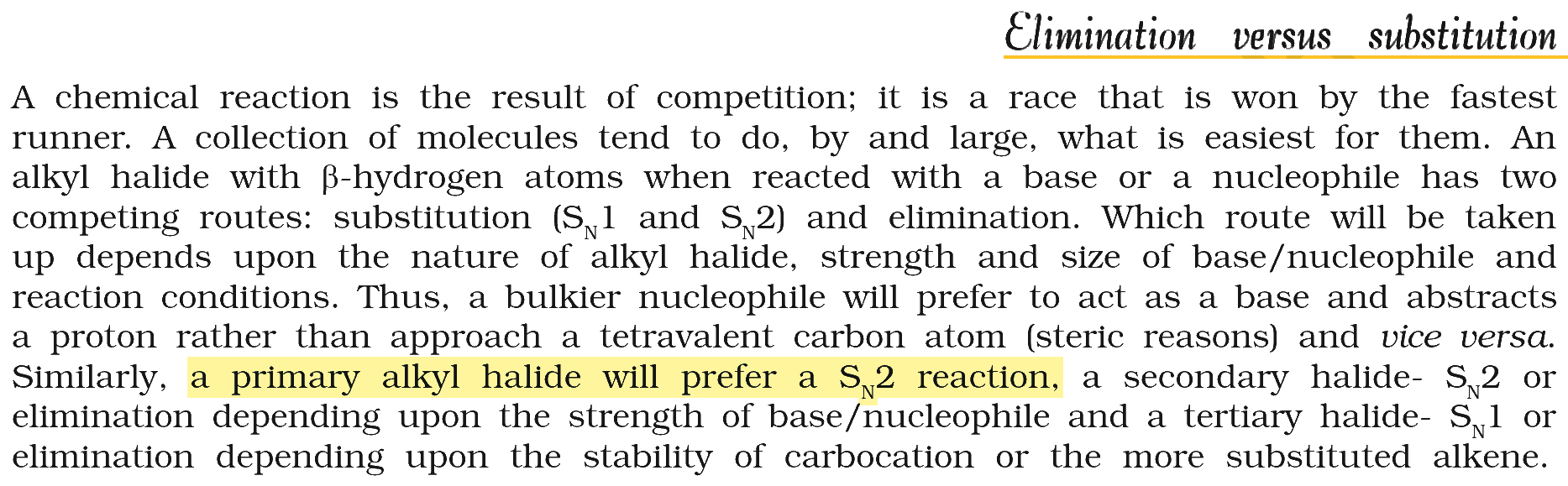
A primary alkyl halide has only one alkyl group on the carbon bearing the halogen. Backside attack is easy, while a primary carbocation would be very unstable. So a primary alkyl halide prefers the SN2 reaction.
Why the other options are incorrect
Option (1) SN1 reaction — Incorrect. It needs a stable carbocation, so it is preferred by tertiary (and benzylic or allylic) halides, not primary ones.
Option (3) α-Elimination — Incorrect. The elimination reaction of alkyl halides is β-elimination (dehydrohalogenation), in which H is lost from the β-carbon; it is favoured by tertiary halides with strong bases.
Option (4) Racemisation — Incorrect. This is not a reaction type but the stereochemical result of an SN1 reaction at a chiral carbon.
NCERT (2026-27 edition):
Elimination versus Substitution