Which of the following when made to react with Grignard reagent does not form hydrocarbon ?
Answer & explanation
Correct answer: option 3
The correct answer is Option (3) → ROR
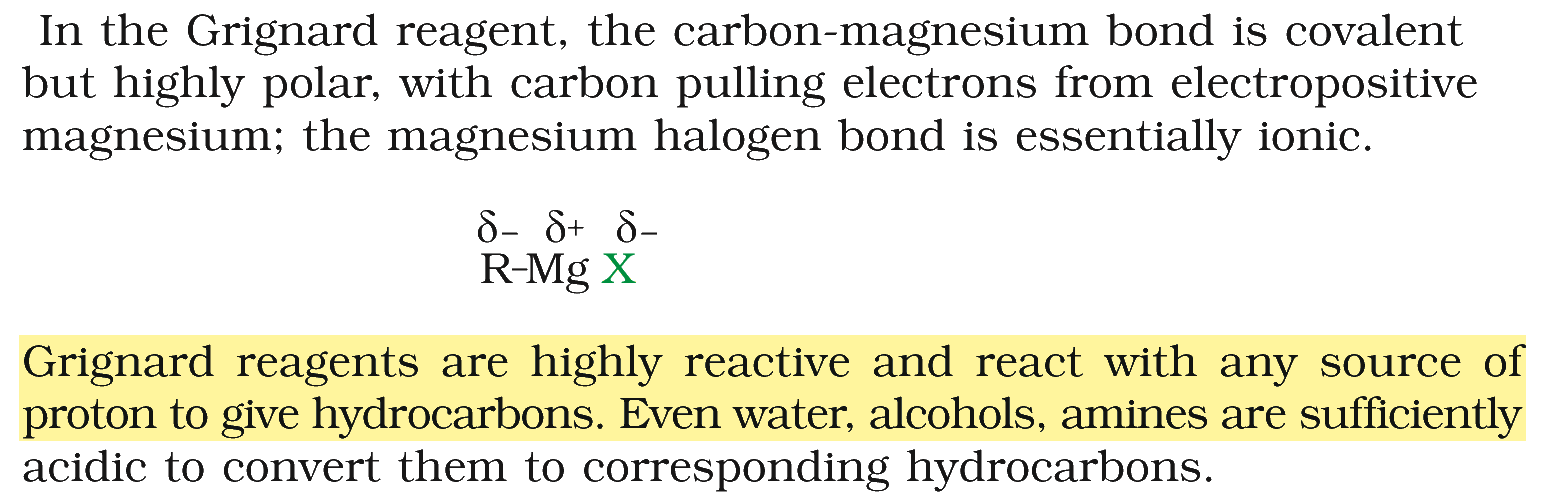
In a Grignard reagent, RMgX, the carbon attached to magnesium carries a partial negative charge, so the alkyl group behaves as a very strong base. It removes a proton from any compound that has a hydrogen attached to oxygen, nitrogen or another electronegative atom, and the alkyl group becomes a hydrocarbon, R–H:
\( \displaystyle \ce{RMgX + H2O -> RH + Mg(OH)X} \)
\( \displaystyle \ce{RMgX + R'OH -> RH + Mg(OR')X} \)
\( \displaystyle \ce{RMgX + R'NH2 -> RH + Mg(NHR')X} \)
Option (1) H2O — Forms a hydrocarbon. Water gives R–H and Mg(OH)X, as shown above.
Option (2) ROH — Forms a hydrocarbon. The O–H hydrogen of an alcohol is removed, giving R–H.
Option (3) ROR — Does not form a hydrocarbon. An ether has no hydrogen on oxygen, so it has no acidic proton to give and does not react with the Grignard reagent. In fact, Grignard reagents are prepared in dry ether.
Option (4) RNH2 — Forms a hydrocarbon. The N–H hydrogen of an amine is removed, giving R–H.
NCERT (2026-27 edition):
Reactions of Haloalkanes – …