Comprehension:
Colligative Properties
Vapour pressure of a solution decreases when a non-volatile solute is added to a volatile solvent. There are many properties of solutions which are connected with this decrease of vapour pressure. These are: (1) relative lowering of vapour pressure of the solvent (2) depression of freezing point of the solvent (3) elevation of boiling point of the solvent and (4) osmotic pressure of the solution. All these properties depend on the number of solute particles irrespective of their nature relative to the total number of particles present in the solution. Such properties are called colligative properties.
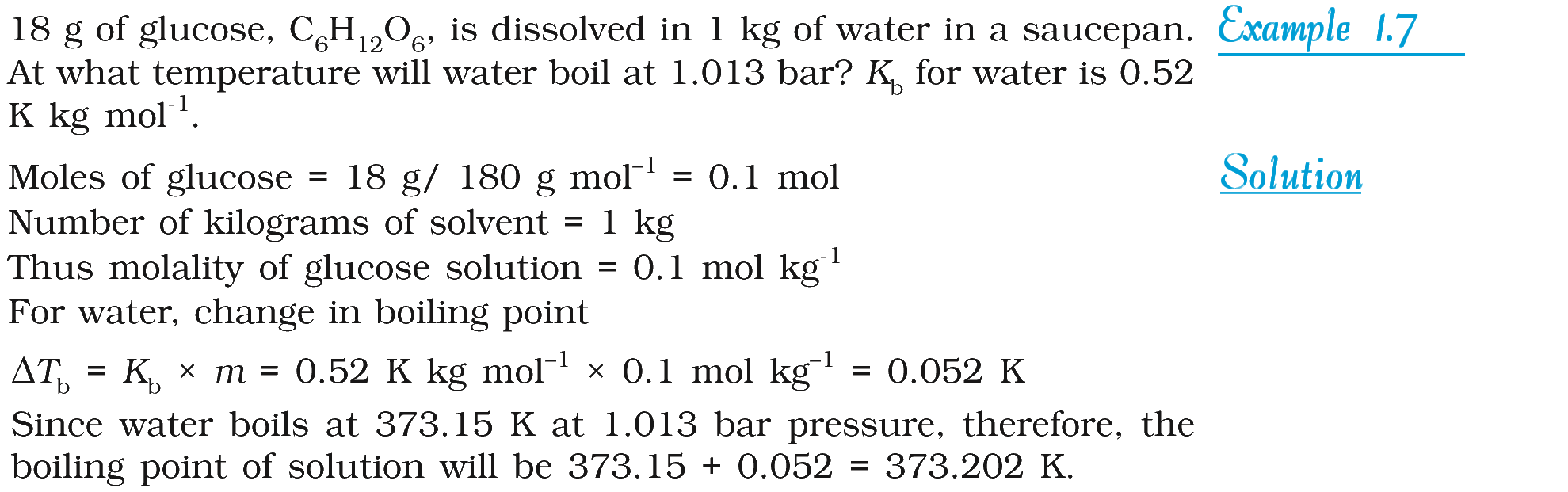
18 g of glucose, C6H12O6 is dissolved in 1 kg of water. What is the boiling point elevation of the given solution? Kb for water is 0.52 K kg mol-1.
Answer & explanation
Correct answer: option 1
The correct answer is Option (1) → 0.052 K
For a dilute solution of a non-volatile solute, the elevation of boiling point is proportional to the molality of the solute particles:
\( \displaystyle \Delta T_b=i\,K_b\,m,\quad m=\frac{\text{moles of solute}}{\text{mass of solvent in kg}} \)
Glucose is a non-electrolyte, so it does not dissociate and i = 1.
\( \displaystyle M(\ce{C6H12O6})=6(12)+12(1)+6(16)=180\ \mathrm{g\,mol^{-1}} \)
\( \displaystyle n=\frac{18\ \mathrm{g}}{180\ \mathrm{g\,mol^{-1}}}=0.1\ \mathrm{mol} \)
\( \displaystyle m=\frac{0.1\ \mathrm{mol}}{1\ \mathrm{kg}}=0.1\ \mathrm{mol\,kg^{-1}} \)
\( \displaystyle \Delta T_b=0.52\ \mathrm{K\,kg\,mol^{-1}}\times0.1\ \mathrm{mol\,kg^{-1}}=0.052\ \mathrm{K} \)
So the elevation of boiling point is 0.052 K.
Shortcut: 18 g is one tenth of the molar mass of glucose, and the solvent is 1 kg, so m = 0.1 and ΔTb = Kb/10.
Note: This question is from NCERT (2026-27). NTA sets numerical questions from NCERT too, so do not ignore NCERT while practising numericals.
NCERT (2026-27 edition):
Elevation of Boiling Point – …