Read the passage carefully and answer the following questions:
Determination of Income in Two-sector Model
In an economy without a government, the ex ante aggregate demand for final goods is the sum total of the ex ante consumption expenditure and ex-ante investment expenditure on such goods. Ex-ante supply is equal to ex ante demand only when the final goods market, and hence the economy, is in equilibrium. If ex ante demand for final goods falls short of the output of final goods that the producers have planned to produce in a given year, stocks will be piling up in the warehouses, which may be considered as an unintended accumulation of inventories. Change in inventory is called inventory investment. It can be negative as well as positive: if there is a rise in inventory, it is positive inventory investment, while a depletion of inventory is negative inventory investment. The inventory investment can take place for two reasons: (i) the firm decides to keep some stocks for various reasons (ii) the sales differ from the planned level of sales, in which case the firm has to add to/run down existing inventories.
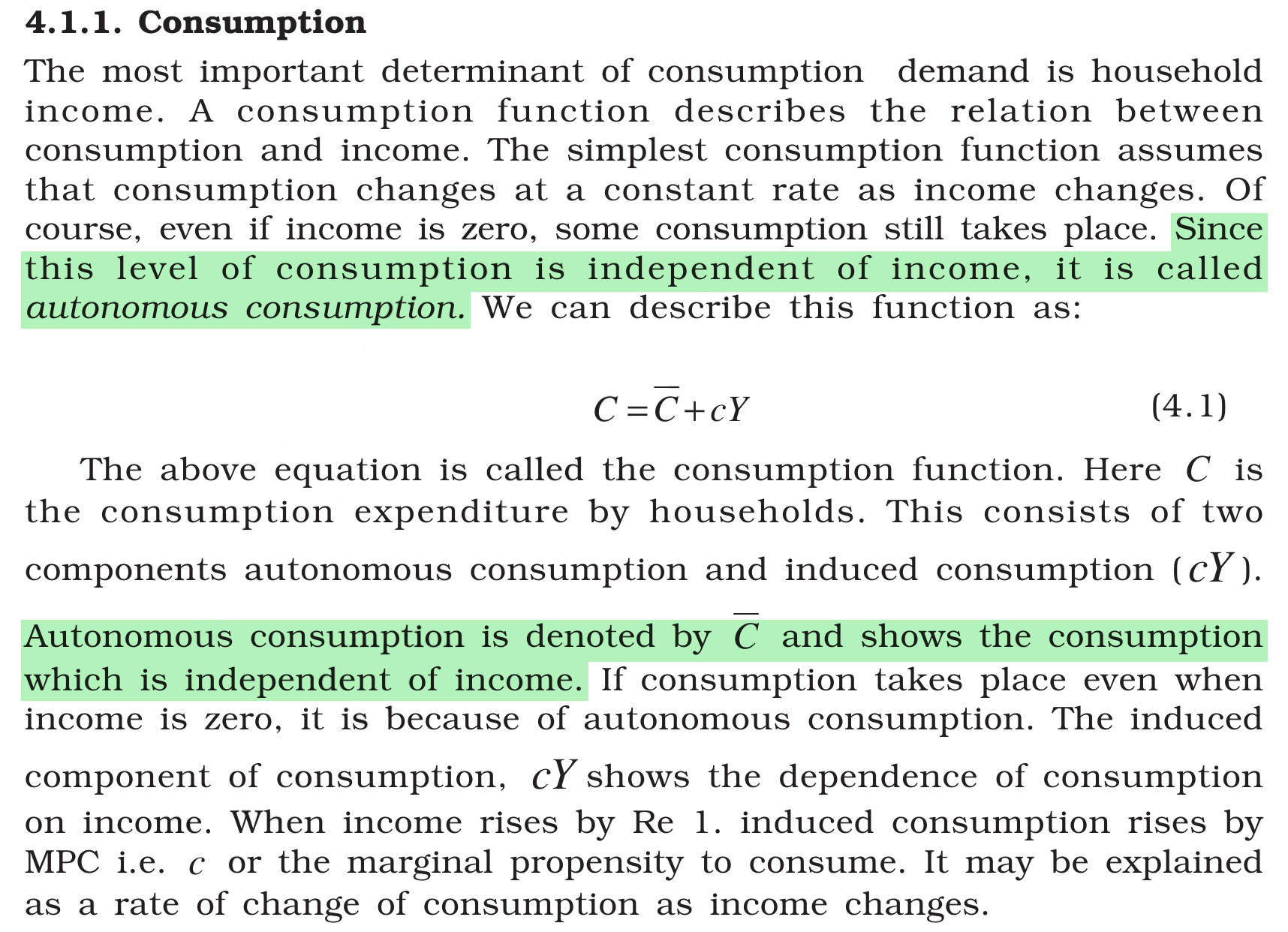
The level of consumption, which is independent of income, is called ?
Answer & explanation
Correct answer: option 1
The correct answer is Option (1) → Autonomous Consumption.
The main thing that decides how much people consume is their income: as income rises, consumption rises. But even a person with no income must eat and live, so some consumption takes place even at zero income. This part, which does not depend on income at all, is autonomous consumption.
In the consumption function C = C̄ + cY, autonomous consumption is the constant term C̄, and cY is the part induced by income.
Why the other options are incorrect
Option (2) Consumption Function. — Incorrect. The consumption function is the whole relation between consumption and income. Autonomous consumption is only one part of it, the part that does not depend on income.
Option (3) Induced Consumption. — Incorrect. Induced consumption, cY, is the part of consumption that is induced by income and changes with it, so it is the opposite of autonomous consumption.
Option (4) Consumption Expenditure. — Incorrect. Consumption expenditure C is the total spent by households, autonomous and induced together.
Note 1: This passage is taken almost word for word from section 4.2 of the Determination of Income and Employment chapter of the NCERT book; only a few words are left out. Read that chapter line by line, equations included. The passage follows the book almost line by line, so it was already an old acquaintance for anyone who had.
Note 2: A same/similar question was asked in CUET (UG) in the papers below.
| 2026 | 2025 | 2024 | 2023 | 2022 |
| 13-05 S1* 13-05 S2 | 02-06 S1* 03-06 S2* | – | 27-05 S1* | – |
* A similar question.
NCERT: Introductory Macroeconomics — Chapter 4: Determination of Income and Employment (2025-26)
|