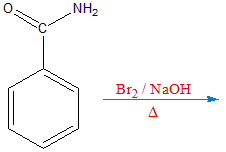
Predict the product for the following reaction:
Answer & explanation
Correct answer: option 2
The correct answer is Option (2) → aniline
In the Hofmann bromamide degradation, an amide is heated with bromine and aqueous or ethanolic NaOH. The –\( \ce{CONH2} \) group is converted into –\( \ce{NH2} \): the alkyl or aryl group moves from the carbonyl carbon to nitrogen, and the carbonyl carbon leaves as carbonate. So the amine formed has one carbon atom less than the amide, and the –\( \ce{NH2} \) group sits on the carbon that carried –\( \ce{CONH2} \).
Benzamide therefore gives aniline:
\( \ce{C6H5CONH2 + Br2 + 4NaOH} \xrightarrow{\Delta} \ce{C6H5NH2 + Na2CO3 + 2NaBr + 2H2O} \)
The \( \ce{NH2} \) is attached directly to the ring, so the product is aniline (\( \ce{C6H5NH2} \)), with seven carbons in benzamide and six in aniline.
Why the other options are incorrect
Option (1) benzylamine (C6H5CH2NH2) — Incorrect. This keeps all seven carbons. It is the product of reducing benzamide with \( \ce{LiAlH4} \), which turns C=O into \( \ce{CH2} \):
\( \ce{C6H5CONH2} \xrightarrow[\text{(ii) }\ce{H2O}]{\text{(i) }\ce{LiAlH4}} \ce{C6H5CH2NH2} \)
Option (3) 3-bromobenzamide — Incorrect. This would be a ring-bromination product. Bromine and NaOH do not substitute the ring here; they attack the N–H of the amide group.
Option (4) 2-bromobenzamide + 4-bromobenzamide — Incorrect. These are also ring-substitution products; the amide group is lost in the reaction, so no bromobenzamide remains.
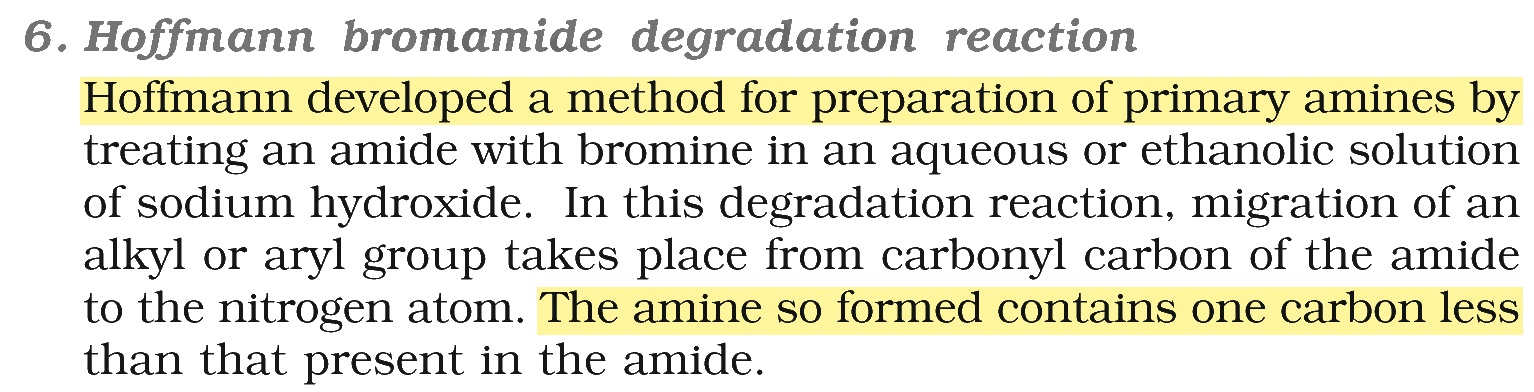
NCERT (2026-27 edition):
Hoffmann Bromamide Degradation Reaction