Match List-I with List-II
| List-I | List-II |
|---|---|
| (A) Equity shareholders are | (I) Issued share capital |
| (B) The maximum amount of share capital which a company is authorised to issue | (II) Owners |
| (C) The profit on the reissue of forfeited shares is not transferred to | (III) Nominal share capital |
| (D) It is that part of the authorised capital which is issued by the company | (IV) Capital redemption reserve |
Choose the correct answer from the options given below:
Answer & explanation
Correct answer: option 3
The correct answer is Option (3) → (A) - (II), (B) - (III), (C) - (IV), (D) - (I)
Each item describes a term used for the share capital of a company.
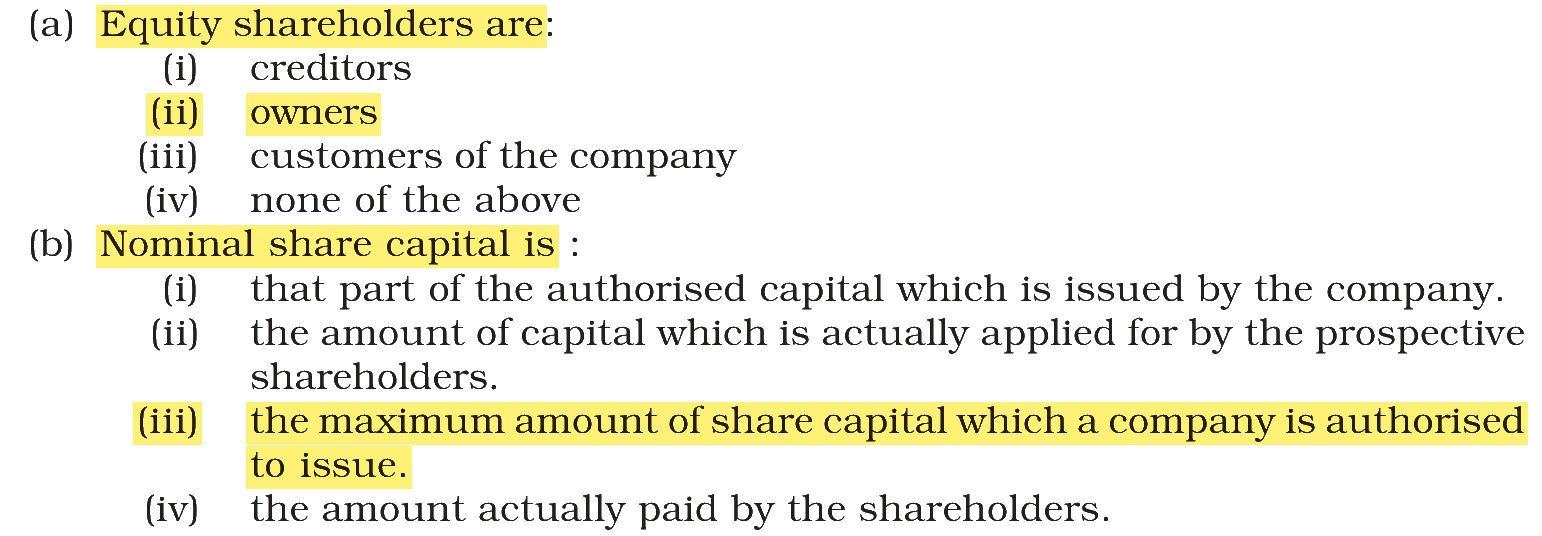
(A) Equity shareholders are — this matches (II) Owners. Equity shareholders own the company and bear its risk; they are not its creditors.
(B) The maximum amount of share capital which a company is authorised to issue — this matches (III) Nominal share capital. This is the authorised capital stated in the Memorandum of Association, also called nominal or registered capital.
(C) The profit on the reissue of forfeited shares is not transferred to — this matches (IV) Capital redemption reserve. That profit goes to Capital Reserve. Capital Redemption Reserve is a different reserve, created out of profits when preference shares are redeemed or shares are bought back.
(D) It is that part of the authorised capital which is issued by the company — this matches (I) Issued share capital. The part of the authorised capital not offered to the public is unissued capital.
NCERT (2026-27 edition):
NCERT (2026-27 edition): |