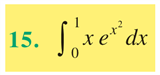
The value of \( \int_{0}^{1}x\,e^{x^2}\,dx \) is equal to :
Answer & explanation
Correct answer: option 4
The correct answer is Option (4) → \( \displaystyle\frac{e-1}{2} \)
Let \( t=x^2 \), so \( dt=2x\,dx \), that is, \( x\,dx=\frac{dt}{2} \). When x = 0, t = 0 and when x = 1, t = 1.
\( \displaystyle \int_{0}^{1}x\,e^{x^2}\,dx=\frac{1}{2}\int_{0}^{1}e^{t}\,dt \)
\( \displaystyle =\frac{1}{2}\left[e^{t}\right]_{0}^{1} \)
\( \displaystyle =\frac{1}{2}(e-1) \)
\( \displaystyle =\frac{e-1}{2} \)
Why the other options are incorrect
Option (1) \( e+1 \) — Incorrect. \( e+1 \) drops the factor \( \frac{1}{2} \) and also adds \( e^0 \) instead of subtracting it.
Option (2) \( \displaystyle\frac{e+1}{2} \) — Incorrect. \( \frac{e+1}{2} \) adds the value at the lower limit instead of subtracting it: \( \left[e^t\right]_0^1=e-1 \).
Option (3) \( e-1 \) — Incorrect. \( e-1 \) forgets the factor \( \frac{1}{2} \) from \( x\,dx=\frac{dt}{2} \).
NCERT (2026-27 edition):
Fundamental Theorem of Calculus