If \(f(x) = x + \displaystyle\frac{1}{x}\). Which of the following is not a correct option ?
Answer & explanation
Correct answer: option 2
The correct answer is Option (2) → local maximum value = −2, local minimum value = 0
For x ≠ 0:
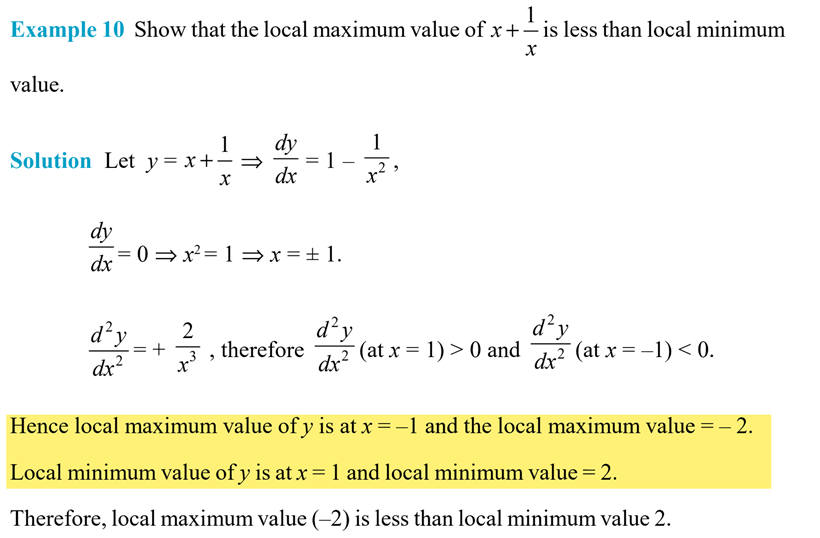
\( \displaystyle f'(x) = 1 - \frac{1}{x^2} \)
\( f'(x) = 0 \Rightarrow x^2 = 1 \Rightarrow x = 1 \text{ or } x = -1 \)
\( \displaystyle f''(x) = \frac{2}{x^3} \)
By the second derivative test:
\(f''(1) = 2 \gt 0\): local minimum, \(f(1) = 2\)
\(f''(-1) = -2 \lt 0\): local maximum, \(f(-1) = -2\)
So the local minimum value is 2 (at x = 1) and the local maximum value is −2 (at x = −1).
Checking the options
Option (1) local minimum value = 2 — Correct. f(1) = 2.
Option (2) local maximum value = −2, local minimum value = 0 — Incorrect. The local minimum value is 2, not 0.
Option (3) extreme occurs at 1, −1 — Correct. f′(x) = 0 only at x = ±1, and f″ is non-zero there.
Option (4) local maximum value = −2 — Correct. f(−1) = −2.
Option (2) is the only statement that is not correct.
NCERT Exemplar:
Application of Derivatives