
CUETMOCK
  • Pricing
  • Mentors
Log inStart freeStart free mocks→

First test, then trust

Try a free CUET mock test.

Join 5,00,000+ students who rehearsed exam day on the exact NTA screen before sitting CUET. On the web and on Android.

Start free mocks →Get the Android app
CUETMOCK

India's #1 CUET Mock Test Platform. Original NCERT-based questions on the exact NTA exam screen — trusted by 5,00,000+ students since CUET 2022.

Get it onGoogle PlayScan to download the CUETMOCK app

Mock tests

  • CUET mock test series
  • Browse all papers
  • Commerce mocks
  • Humanities (Arts) mocks
  • Science mocks
  • Languages & GAT mocks
  • Free practice questions
  • Pricing

Resources

  • CUET exam guide
  • CUET syllabus
  • Universities accepting CUET
  • Expert blogs
  • News & notifications
  • Webinars & counselling
  • CUET score calculator
  • How we estimate your rank
  • FAQs

Company

  • About us
  • Our leadership & team
  • Our toppers
  • Mentors
  • For schools
  • Contact us
  • Terms
  • Privacy
  • Refund policy

Talk to us

+91 7696 6630 56info@cuetmock.comWhatsApp us

Our other platforms

  • JEE Mock — For IIT-JEE aspirants
  • NEET Mock — For NEET aspirants

Newsletter

Exam updates, study material and offers — no spam.

© 2026 NYC Ventures Pvt. Ltd.

701-702, Royal Business Park, Zirakpur, Punjab - 140603

  • Terms of use
  • Privacy policy
  • Refund policy
  • Contact us

iCUETMOCK is an independent preparation platform, not affiliated with the National Testing Agency (NTA). Always check exam details on the official NTA website.

  • Home
  • Mock tests
  • CUET guide
  • Pricing
  • Log in
Home/Practice questions/General Aptitude Test
General Aptitude TestVerbal ReasoningVenn Diagram

In the given Venn diagram, the ‘rectangle’ represents ‘engineers’, th…

In the given Venn diagram, the ‘rectangle’ represents ‘engineers’, the ‘circle’ represents ‘managers’, and the ‘triangle’ represents ‘married’. The numbers given in the diagram represent the number of persons in that particular category.
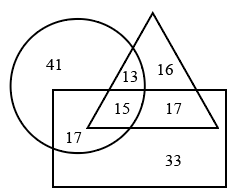
How many people are married but are NOT engineers?

Answer & explanation+

Correct answer: option 1

The ‘rectangle’ represents ‘engineers’

The ‘circle’ represents ‘managers’

The ‘triangle’ represents ‘married’

Step 1 ) Look at the figure of Triangle , circle and rectangle

Step 2) Look at  number given in people are married but are NOT engineers

Step 3) By visual observations we conclude that (16 +13 = 29) is the number which represents people are married but are NOT engineers

Advertisement

Practise more on Verbal Reasoning

Chapter-wise mocks on the real NTA exam screen, with solutions and your rank. Your first mocks are free.

Start free mocks →

Advertisement

Next questions

  1. Which of the following pairs of a government measure for agricultural marketing and a fact about it is correctly matched?Economics · Indian Economic Development: Rural Development
  2. Amount refunded on rejection of applications:Accountancy Part A · Accounting for Shares
  3. What historical factor made merchants, traders, and local chieftains powerful patrons of art in Western India? 1) Industrialization 2) Pres…Fine Arts · The Manuscript Painting Tradition
  4. Why is control often resisted by employees?Business Studies · Controlling
  5. The perimeter of a right triangle is 60 cm and its hypotenuse is 26 cm. What is the area (in cm2) of the triangle?General Aptitude Test · Quantitative Reasoning
  6. Pastoral nomadism is a ________ .Geography · Fundamentals of Human Geography: Primary Activities
  7. Barrier potential of a P-N junction diode does not depend onPhysics · Semiconductors and Electronic Devices
  8. सूची-I को सूची-II से सुमेलित कीजिए: सूची-I शब्द सूची-II संधि (A) भवन (I) अयादि संधि (B) त्रिभुजाकार (II) यण संधि (C) ज्ञानेश (III) दीर्घ सं…Hindi · व्याकरण - सन्धि
  9. In which town The Supreme Court was established for the First time under the Regulating Act of 1773?General Aptitude Test · General Knowledge
  10. Which of the following is NOT correct about groups and teams?Psychology · Social Influence and Group Processes