
Potentiometer has multiple uses. It is based on the principle that when constant current flows through a wire of uniform area of cross-section then potential drop along its length is directly proportional to corresponding length.
i.e. \( V \propto l \) ; \( V = K l \)
Various uses of potentiometer on :
- To measure potential differences between any two points in an electrical network
- To compare emf of a cell
- To measure emf of a cell
- To measure internal resistance of a cell etc:
Answer the following question related to potentiometer.
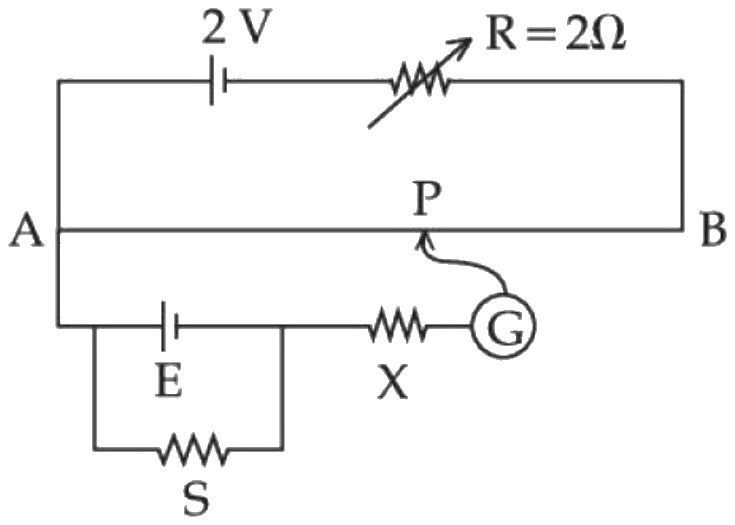
What happens to the balancing length when resistance S is increased?
Answer & explanation
Correct answer: option 2
The correct answer is Option (2) → Balancing length increases
At the balance point no current flows through the galvanometer, so the potentiometer measures the potential difference across the terminals of the cell E, and \( V = k\,l \), where \( k \) is the potential gradient of the wire.
In the figure the resistance S is connected directly across the cell E, so the cell drives a current through S all the time. If \( r \) is the internal resistance of the cell, its terminal voltage is
\( \displaystyle V = E - I r = E - \frac{E}{S + r}\,r = \frac{E\,S}{S + r} \)
The driver circuit (2 V cell, R and wire AB) is not changed, so \( k \) stays the same and
\( \displaystyle l = \frac{V}{k} = \frac{E\,S}{k\,(S + r)} \)
When S is increased, the current drawn from the cell falls, the drop \( I r \) inside the cell falls and the terminal voltage rises towards E. Hence the balancing length increases.