Read the paragraph below and answer the following question.
The famous isolation versus integration debate of the 1940s built upon this standard picture of tribal societies as isolated wholes. The isolationist side argued that tribals needed protection from traders, moneylenders and Hindu and Christian missionaries all of whom were intent on reducing tribals to detribalised landless labour. The integrationists, on the other hand, argued that tribals were merely backward Hindus, and their problems had to be addressed within the same framework as that of backward classes. This opposition dominated the Constituent Assembly debates, which were finally settled along the lines of a compromise which advocated welfare schemes that would enable controlled integration. The subsequent schemes for tribal development - five year plans, tribal sub-plans, tribal welfare blocks, special multipurpose area schemes all continue with this mode of thinking. But the basic issue here is that the integration of tribes has neglected their own needs or desires; integration has been on the terms of the mainstream society and for its own benefit. The tribal societies have had their lands, forests taken away and their communities shattered in the name of development.
Which of the following is not part of integration framework:
Answer & explanation
Correct answer: option 3
The correct answer is Option (3) → Meghalaya Succession Act
Note 1: The given answer is as per the official NTA Answer Key. However, the question can have more than one correct answer, i.e. both Option (3) and Option (4), as explained below.
Option (1) Tribal sub-plans — Part of the integration framework (Incorrect). The Constituent Assembly debates ended in a compromise of welfare schemes that would enable controlled integration. The later schemes for tribal development, among them the tribal sub-plans, all continue with this mode of thinking.
Option (2) Tribal welfare blocks — Part of the integration framework (Incorrect). Tribal welfare blocks are named in the same list of schemes for tribal development that follow the idea of controlled integration.
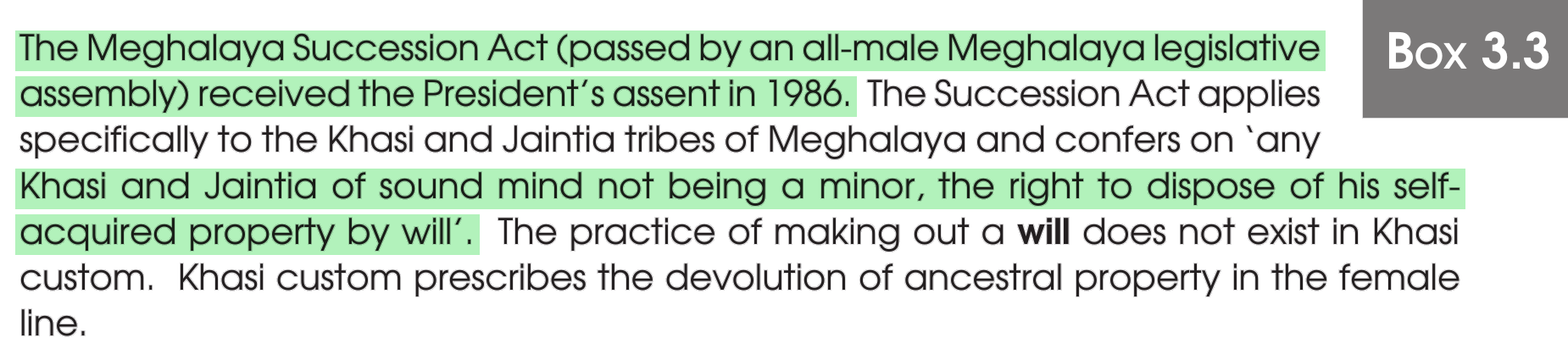
Option (3) Meghalaya Succession Act — Not part of the integration framework (Correct as per NTA). This Act, which received the President’s assent in 1986, gave any Khasi and Jaintia person the right to dispose of self-acquired property by will. It is a law on inheritance among two tribes of Meghalaya, not a development or welfare scheme of controlled integration.
Option (4) Protection to religious minorities — Not part of the integration framework (Can also be considered correct). The schemes for tribal development that continue controlled integration are listed as five year plans, tribal sub-plans, tribal welfare blocks and special multipurpose area schemes. Protection to religious minorities is not one of them; it concerns religious communities, not the development of tribes.
Tip for students: In a ‘not part of’ question, check every option against the list of schemes for tribal development. Here only Options (1) and (2) are in that list, so both Option (3) and Option (4) fall outside it; Option (3) is the answer given by NTA here.
Note 2: The section ‘Mainstream Attitudes towards Tribes’ and Box 3.3 on the Khasi matrilineal family, which carries the Meghalaya Succession Act, in the chapter ‘Social Institutions: Continuity and Change’, were there in the pre-rationalised NCERT, which NTA followed in 2023. Both have been deleted from the NCERT book (2025-26), though the chapter is still there.
NCERT (Pre-rationalised): “MAINSTREAM ATTITUDES TOWARDS TRIBES …The famous isolation versus integration debate of the 1940s built upon this standard picture of tribal societies as isolated wholes. The isolationist side argued that tribals needed protection from traders, moneylenders and Hindu and Christian missionaries, all of whom were intent on reducing tribals to detribalised landless labour. The integrationists, on the other hand, argued that tribals were merely backward Hindus, and their problems had to be addressed within the same framework as that of other backward classes. This opposition dominated the Constituent Assembly debates, which were finally settled along the lines of a compromise which advocated welfare schemes that would enable controlled integration. The subsequent schemes for tribal development – five year plans, tribal sub-plans, tribal welfare blocks, special multipurpose area schemes all continue with this mode of thinking. But the basic issue here is that the integration of tribes has neglected their own needs or desires; integration has been on the terms of the mainstream society and for its own benefit. The tribal societies have had their lands, forests taken away and their communities shattered in the name of development.”
NCERT (Pre-rationalised): Box 3.3 |