Match List-I with List-II
| List-I | List-II |
| (A) Currency + Demand Deposits + Savings deposits with Post Office savings banks | (I) M4 |
| (B) Currency + Demand Deposits + Net time deposits of commercial banks + Total deposits with Post Office | (II) M2 |
| (C) Currency + Demand Deposits | (III) M3 |
| (D) Currency + Demand Deposits + Net time deposits of commercial banks | (IV) M1 |
Choose the correct answer from the options given below:
Answer & explanation
Correct answer: option 2
The correct answer is Option (2) → (A)-(II), (B)-(I), (C)-(IV), (D)-(III)
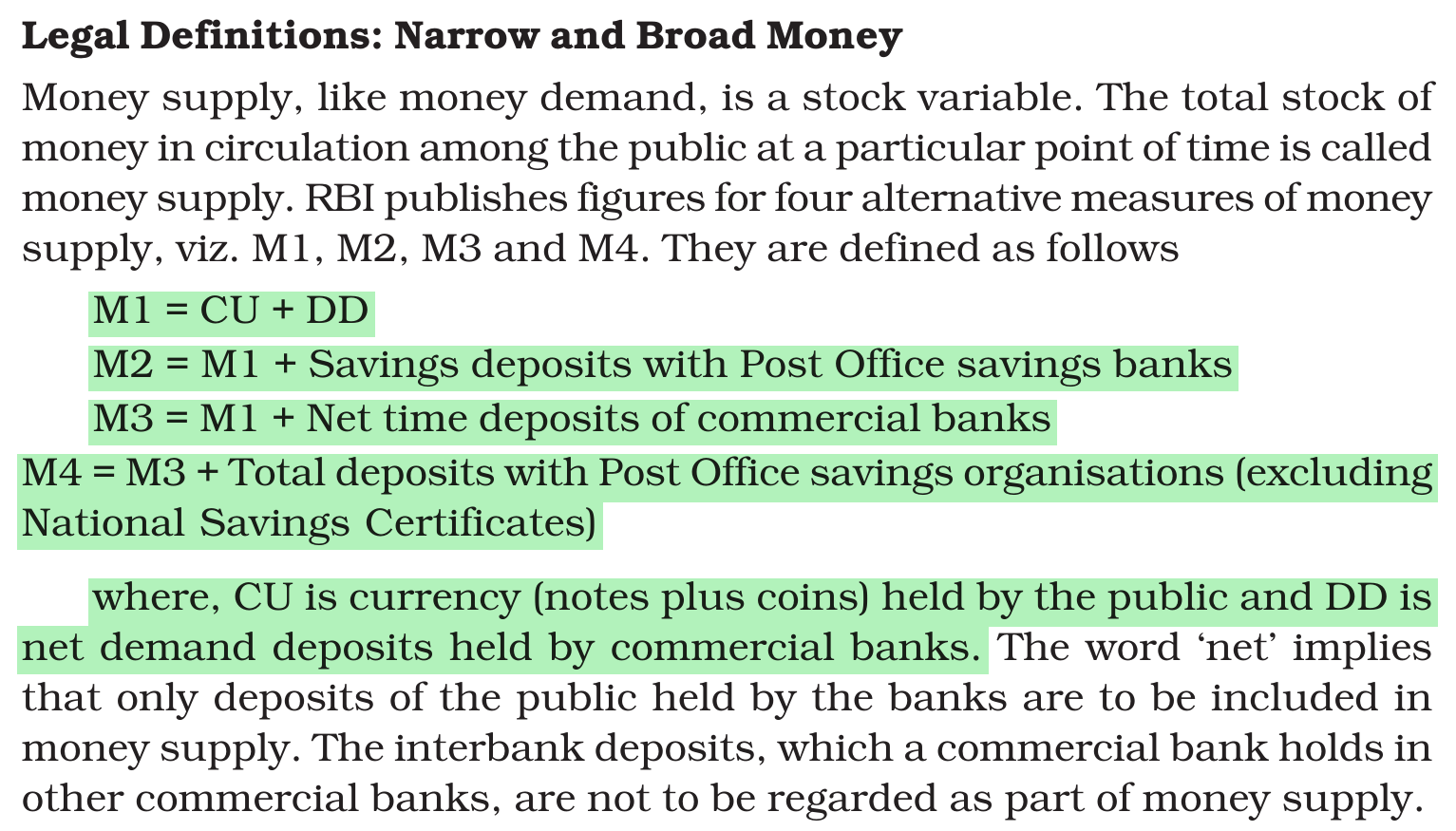
The money supply is the total stock of money in circulation among the public at a point of time. The RBI gives four measures of it, M1 to M4. Each of M2, M3 and M4 adds a kind of deposit to a narrower measure.
| List-I | List-II | Reason |
|---|---|---|
| (A) Currency + Demand Deposits + Savings deposits with Post Office savings banks | (II) M2 | M2 = M1 + savings deposits with Post Office savings banks. |
| (B) Currency + Demand Deposits + Net time deposits of commercial banks + Total deposits with Post Office | (I) M4 | M4 = M3 + total deposits with Post Office savings organisations. It is the widest measure. |
| (C) Currency + Demand Deposits | (IV) M1 | M1 = currency held by the public + net demand deposits held by commercial banks. |
| (D) Currency + Demand Deposits + Net time deposits of commercial banks | (III) M3 | M3 = M1 + net time deposits of commercial banks. |
NCERT (2026-27): Introductory Macroeconomics — Chapter 3: Money and Banking
|