Read the passage given below and answer.
From the Fifth Report
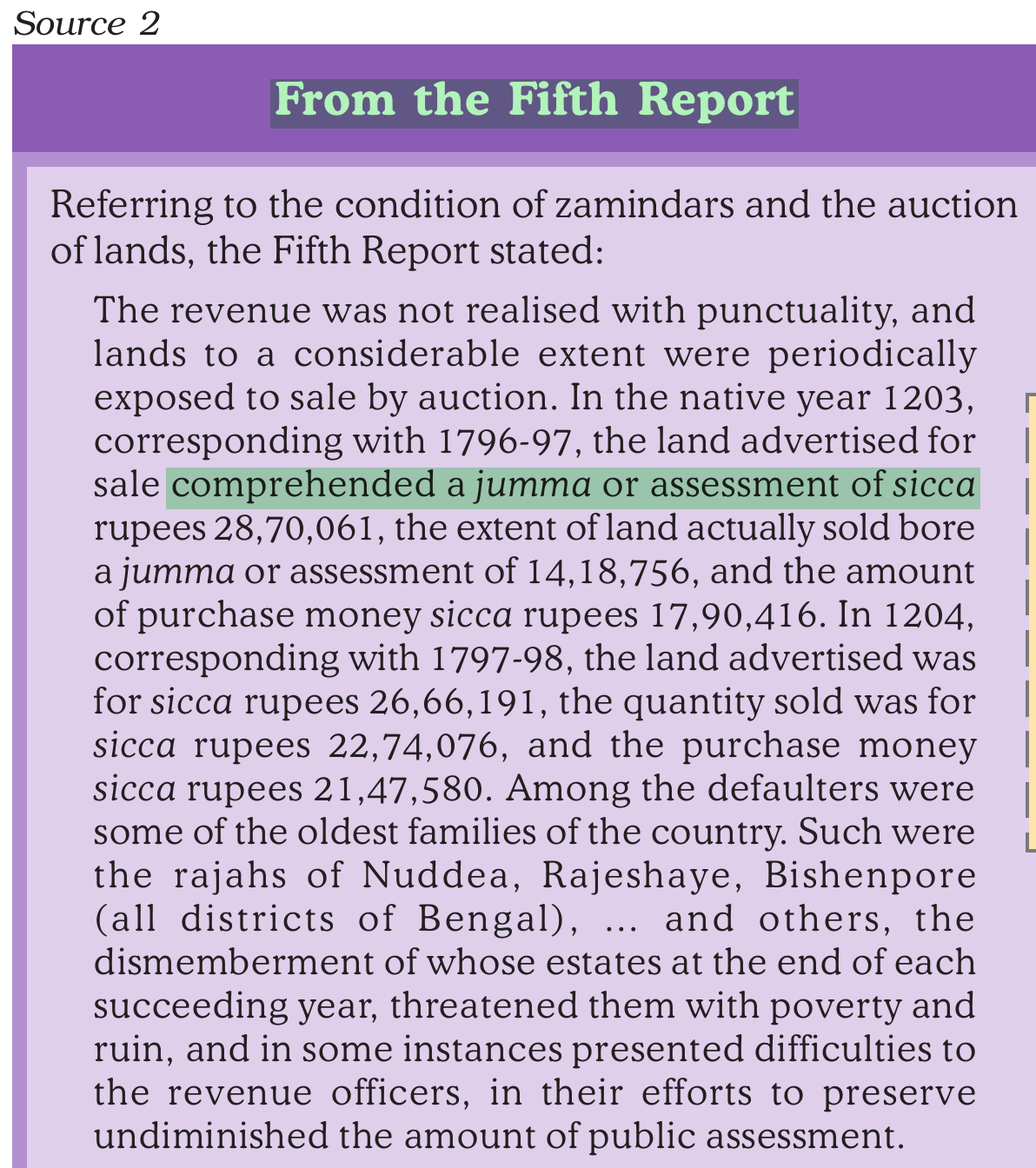
Referring to the condition of zamindars and the auction of lands, the Fifth Report stated: The revenue was not realised with punctuality, and lands to a considerable extent were periodically exposed to sale by auction. In the native year 1203, corresponding with 1796-97, the land advertised for sale comprehended a jumma or assessment of sicca rupees 28,70,061, the extent of land actually sold bore a jumma or assessment of 14,18,756, and the amount of purchase money sicca rupees 17,90,416. In 1204, corresponding with 1797-98, the land advertised was for sicca rupees 26,66,191, the quantity sold was for sicca rupees 22,74,076, and the purchase money sicca rupees 21,47,580. Among the defaulters were some of the oldest families of the country. Such were the rajahs of Nuddea, Rajeshaye, Bishenpore (all districts of Bengal),... and others, the dismemberment of whose estates at the end of each succeeding year, threatened them with poverty and ruin, and in some instances presented difficulties to the revenue officers, in their efforts to preserve undiminished the amount of public assessment.
According to the passage, meaning of 'jumma' is _______.
Answer & explanation
Correct answer: option 3
The correct answer is Option (3) → Official assessment of Land Revenue
The passage itself explains the word: the land advertised for sale “comprehended a jumma or assessment of sicca rupees 28,70,061”. The jumma is the revenue the state had officially assessed on that land.
Option (1) Amount collected as Land Revenue — Incorrect. The jumma is the demand, not what was paid. The Report in fact complains that the revenue was not realised with punctuality, which is why the lands were put up for sale.
Option (2) Amount collected from auction of land — Incorrect. The passage gives the money paid at the auctions separately, as the “purchase money” (sicca rupees 17,90,416 in 1796-97).
Option (4) Amount expected from auction of land — Incorrect. The jumma belongs to the land itself, both to the land advertised and to the land actually sold; it is not a price expected at the sale.
NCERT: Themes in Indian History Part III — Chapter 9: Colonialism and the Countryside (2026-27)
|