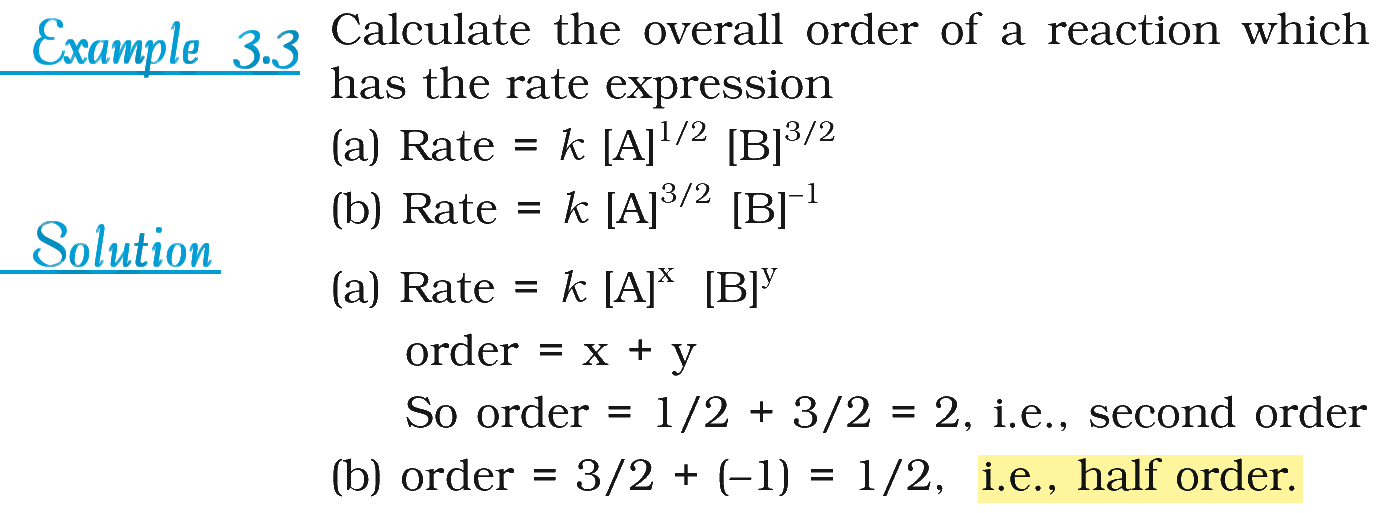
For a reaction, A + B → Product; the rate law is given by, Rate = k [A]3/2[B]–1. What is the order of the reaction?
Answer & explanation
Correct answer: option 2
The correct answer is Option (2) → 1/2 order
The order of a reaction is the sum of the powers of the concentration terms in the rate law. It is found by experiment, not from the balanced equation, so it can be zero, a fraction or even negative. For a rate law
\( \displaystyle \mathrm{Rate}=k[\mathrm{A}]^x[\mathrm{B}]^y \)
the order with respect to A is x, the order with respect to B is y, and the order of the reaction is x + y.
Here the rate law is Rate = k[A]3/2[B]−1, so x = 3/2 and y = −1:
\( \displaystyle \text{Order}=\frac{3}{2}+(-1) \)
\( \displaystyle \text{Order}=\frac{3}{2}-1=\frac{1}{2} \)
So the reaction is of 1/2 order.
Note: This question is from NCERT (2026-27). NTA sets numerical questions from NCERT too, so do not ignore NCERT while practising numericals.
NCERT (2026-27 edition):
Order of a Reaction – …