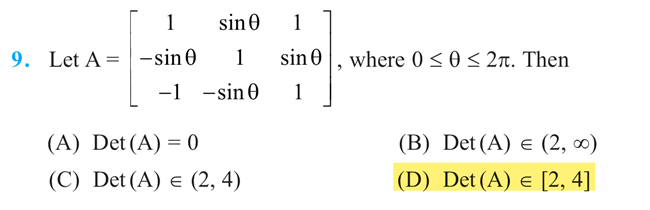
If \( A=\begin{bmatrix}1 & \sin\theta & 1\\-\sin\theta & 1 & \sin\theta\\-1 & -\sin\theta & 1\end{bmatrix} \), where \( 0\le\theta\le 2\pi \), then the value of |A| lies in/equal to
Answer & explanation
Correct answer: option 4
The correct answer is Option (4) → [2,4]
Writing s for sin θ and expanding along R1:
\( \displaystyle |A|=1\begin{vmatrix}1 & s\\-s & 1\end{vmatrix}-s\begin{vmatrix}-s & s\\-1 & 1\end{vmatrix}+1\begin{vmatrix}-s & 1\\-1 & -s\end{vmatrix} \)
\( \displaystyle =(1+s^2)-s(-s+s)+(s^2+1) \)
\( \displaystyle =2+2\sin^2\theta \)
For \( 0\le\theta\le 2\pi \), \( 0\le\sin^2\theta\le 1 \), and both end values are reached (at θ = 0 and θ = π/2):
\( \displaystyle 2\le 2+2\sin^2\theta\le 4 \)
\( \displaystyle |A|\in[2,4] \)
Why the other options are incorrect
Option (1) 0 — Incorrect. |A| = 2 + 2 sin2θ is at least 2, so it is never 0.
Option (2) \( (2,\infty) \) — Incorrect. |A| can never exceed 4, since \( \sin^2\theta\le 1 \).
Option (3) (2,4) — Incorrect. The open interval leaves out the end values, but |A| = 2 at θ = 0 and |A| = 4 at θ = π/2, so both ends are included.
NCERT (2026-27 edition):
Determinants